Giovanni Paolo Panini: The Master of Roman Ruins and Golden Light
In short: Panini captured the theatrical grandeur of Rome during the Grand Tour, blending precise architectural perspective with warm, luminous landscapes that bring classical elegance to modern walls.
The Man Who Painted Rome's Golden Age
In the eighteenth century, wealthy European travelers embarked on the "Grand Tour"—a cultural pilgrimage across Italy to absorb the remnants of classical antiquity. If they wanted a magnificent souvenir to prove they had witnessed the majesty of Rome, they sought out the work of Giovanni Paolo Panini. Panini was the preeminent chronicler of the Eternal City, capturing its towering ruins and bustling piazzas with a unique blend of theatrical drama and scientific precision.
Operating at the intersection of late Baroque theatricality and emerging Neoclassical order, Panini's work defined the visual legacy of Rome. His canvases did not just document stone and mortar; they captured a mood of romantic contemplation that captivated the eighteenth-century imagination.
The Art of the Veduta and the Capriccio
Panini's mastery was built on a deep understanding of space and illusion. Before he became a celebrated painter, he trained in stage design, learning how to manipulate lines and angles to make flat surfaces look infinitely deep. This expertise shines in his vedute (highly detailed, realistic view paintings) and his capricci (imaginative landscapes where famous ruins from different parts of Rome were poetically assembled into a single, dreamlike scene).
In the Full Giovanni Paolo Panini collection, you can see how he used rigorous linear perspective to guide the eye through soaring arches and crumbling temples, making the viewer feel as though they could step right into the canvas.
Light, Scale, and the Human Touch
What prevents Panini's architectural marvels from feeling cold or academic is his treatment of light and humanity. He bathed his stone monuments in a warm, luminous golden Roman light that softens the hard edges of the marble and casts long, dramatic shadows. Beneath these towering structures, he painted lively, expressive figures—tourists, priests, beggars, and soldiers.
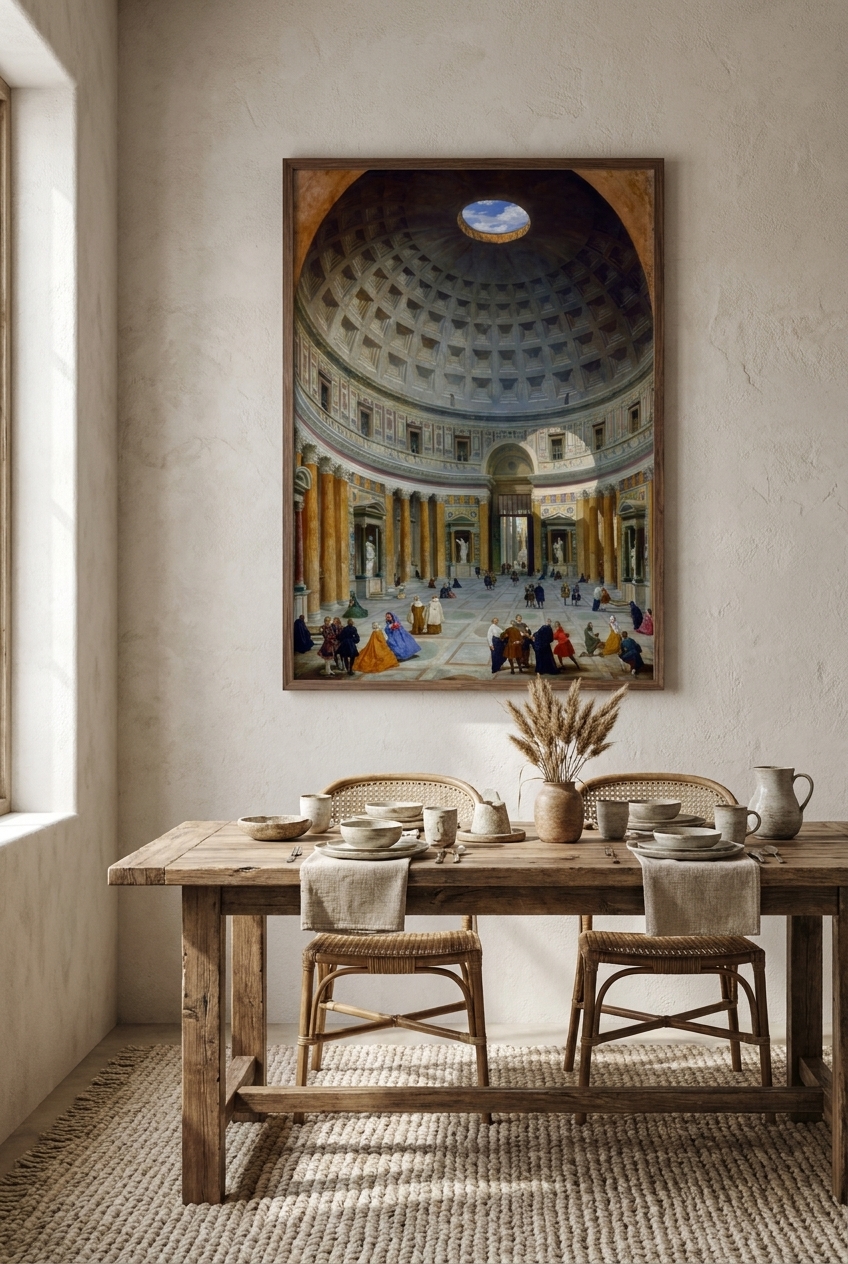
This contrast between the massive, enduring weight of ancient stone and the fleeting, energetic movement of daily human life gives his work a poetic depth. A prime example of this is his famous Interior of the Pantheon, Rome, where the sun streams through the great oculus, illuminating a vibrant crowd gathered below the ancient dome.
Why Panini Belongs on Your Modern Walls
For a modern home, a fine-art print or canvas of a Panini painting does something extraordinary: it acts as an architectural window. Because of his mastery of perspective, his works visually expand a room, adding a sense of depth and grand scale to a living room, study, or hallway.
The warm, sun-drenched palette of ochre, cream, and sky blue brings a cozy, classical elegance to contemporary interiors. Whether you choose a faithful view of a Roman landmark or a whimsical, ruin-filled fantasy, Panini's art offers a timeless escape into a golden, monumental past.
Frequently asked questions
What is the difference between a "veduta" and a "capriccio"?
A veduta is a highly accurate, realistic painting of a specific city view. A capriccio is a fantasy landscape where real architectural elements and ruins from different locations are creatively arranged into a single, imaginary scene.
Why are there so many small figures in Panini's paintings?
These figures, known as staffage, serve two purposes: they show the scale of the massive Roman ruins, and they add narrative life, humor, and a sense of contemporary energy to the ancient, silent architecture.
How did Panini's background influence his painting style?
Panini trained in stage design and perspective drawing. This theatrical background gave him a unique ability to construct dramatic, deep spaces and manipulate light to create a sense of grand, stage-like presentation on a flat canvas.