How did an engraver capture the vast American West?
In short: By translating Albert Bierstadt's massive, glowing oil paintings into incredibly detailed steel engravings, James Smillie brought the awe-inspiring beauty of the American frontier into the homes of nineteenth-century art lovers—a feat of graphic genius that remains stunning today.
How did steel and ink capture the glow of the American West?
In the mid-nineteenth century, painter Albert Bierstadt took the art world by storm with his colossal, light-filled canvases of the American frontier. These paintings were theatrical events, drawing massive crowds who paid just to stand in front of them. But how could these giant, glowing oil paintings be shared with a wider public before the age of color photography? The answer lay in the extraordinary hands of master engraver James Smillie.
Smillie answered this challenge by translating Bierstadt's vibrant, atmospheric colors into a sophisticated language of black and white. Using a steel plate, a sharp hand tool called a burin, and infinite patience, Smillie recreated the luminous skies, rushing waterfalls, and towering mountain peaks of the West. Through his work, the epic scale of the frontier was transformed into a deeply personal, graphic masterpiece that anyone could appreciate up close. You can explore this incredible partnership in the Full James Smillie, after Albert Bierstadt collection.
The meticulous craft of translating light to metal
To understand Smillie's genius, you have to look closely at the texture of his prints. Bierstadt was a master of Luminism, a style focused on the spiritual, glowing quality of light. Translating this soft, ethereal glow onto a hard steel plate required unmatched technical skill. Smillie could not use washes of paint; he had only lines, dots, and ink.
To capture the appearance of alpine mist rising from a valley or sunlight breaking through heavy storm clouds, Smillie used an intricate network of fine lines, delicate cross-hatching, and stippling (dots of varying density). By changing the depth and spacing of these cuts, he controlled how much ink the plate would hold, creating a breathtaking range of tones from brilliant, untouched white to deep, velvety shadows. It was a slow, meditative process that took months, sometimes years, to complete for a single image.
A closer look at a monumental masterpiece
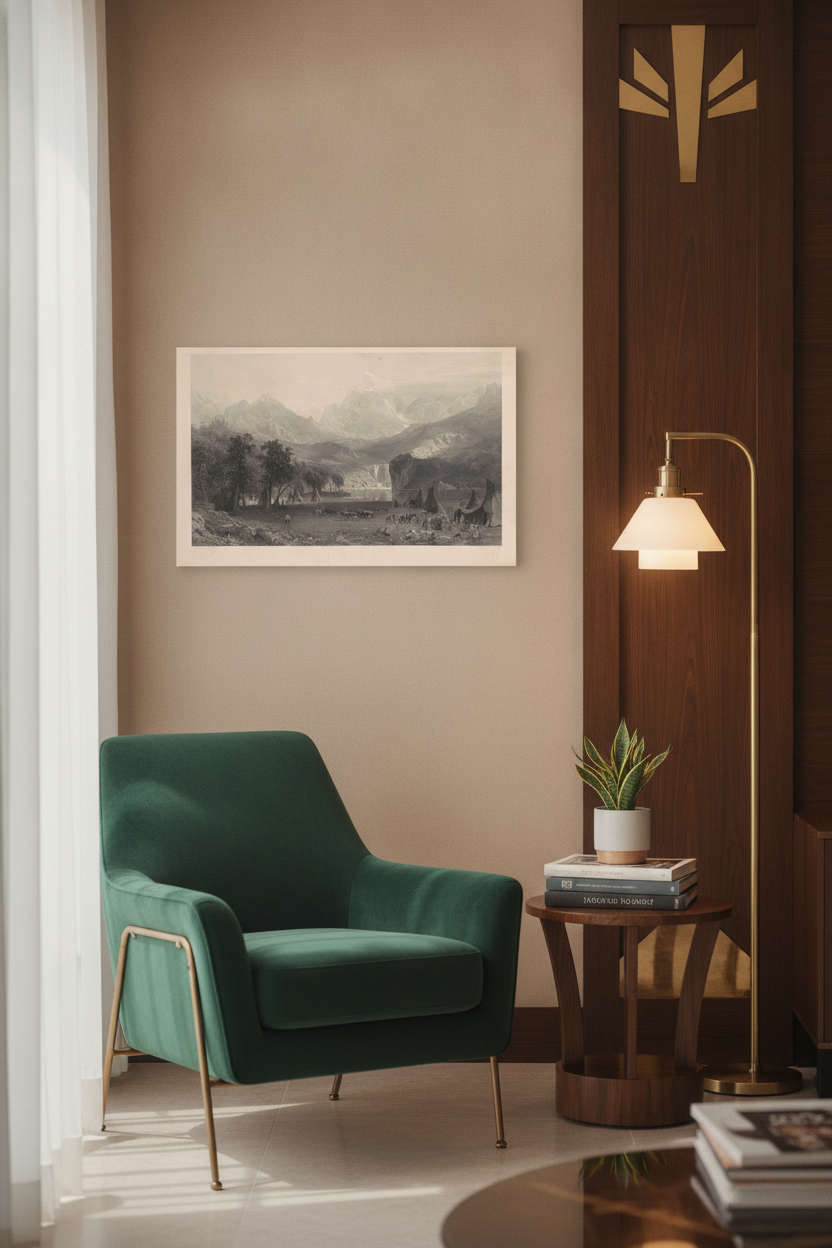
Perhaps the finest example of this collaboration is the engraving of "The Rocky Mountains" (1866). The scene is grand and theatrical, showing a majestic peak rising high above a bustling Native American encampment nestled by a glassy lake.
In Smillie's engraving, the composition gains a new kind of clarity. While the original painting relies on color to separate the foreground from the distant mountains, the engraving uses texture. The details of the camp in the foreground—the horses, the tents, the small figures—are sharp and immediate. As your eye travels up toward Lander's Peak, the lines become incredibly soft and fine, perfectly mimicking the way atmosphere makes distant mountains fade into the sky. It is a masterclass in visual depth.
Why these historic prints belong in modern homes
While Bierstadt's original paintings are massive museum pieces, Smillie's engravings were always meant to be lived with. That makes them uniquely suited for modern homes. The clean, monochromatic palette of a steel engraving offers a timeless, sophisticated aesthetic that fits beautifully into contemporary spaces.
Whether framed on a minimalist gallery wall or placed as a focal point in a cozy study, these prints invite you to step closer. Every time you look at them, you discover a new detail: a tiny figure on a trail, the reflection of a pine tree in the water, or the sheer variety of lines used to create a single cloud. They bring a sense of history, quiet drama, and the wild spirit of the American wilderness into your everyday life.
Frequently asked questions
Who was James Smillie?
James Smillie (1807–1885) was a Scottish-born engraver who immigrated to the United States and became one of the country's most celebrated steel engravers. He was highly sought after for his ability to translate complex landscape paintings into detailed, high-quality prints.
What is the difference between an engraving and a painting?
While Albert Bierstadt painted the original scenes in oil on large canvases, James Smillie hand-carved those designs into steel plates. Ink was then applied to the plate and pressed onto paper. This allowed the images to be reproduced and enjoyed by a wider audience, offering a unique, highly detailed graphic quality.
How did Smillie capture the glowing light of the original paintings?
Smillie used a technique called line engraving, varying the thickness, spacing, and pattern of his carved lines to control how much ink was transferred to the paper. By leaving some areas entirely blank and densely hatching others, he created the illusion of brilliant sunlight, deep shadows, and soft mist.