How does Clayton Clements capture quiet harmony?
In short: Clayton Clements achieved a sense of enduring quietude by applying classical principles of balance, precise tonal graduation, and sculptural light to his subjects.
The Search for Ideal Balance
How does an artist turn a simple, everyday subject into an object of timeless contemplation? For Clayton Clements, the answer lay in the strict but beautiful rules of the Classical tradition. Working with a deep reverence for antiquity and the natural order, Clements sought to distill the chaotic, busy world around him into scenes of serene, enduring harmony. His work is defined by an academic rigor that prioritizes structural balance, making even the simplest subjects feel monumental, balanced, and calm.
In the early twentieth century, Clements applied this classical sensibility to documenting traditional American crafts and design. By exploring the Clayton Clements collection, one can see how he elevated humble, hand-carved objects into high art through sheer precision and balanced composition. He did not merely record what he saw; he sought the ideal beauty hidden within the form, stripping away the temporary to reveal the permanent.
Light as a Sculptural Tool
The true magic of Clements's style lies in his masterful command of light. In his hands, light is not just something that illuminates a room; it is a structural element that builds the shape of the object itself. Through deliberate, measured brushwork and subtle tonal graduation, he coaxes three-dimensional depth out of flat paper, creating a quiet grandeur that commands attention without shouting.
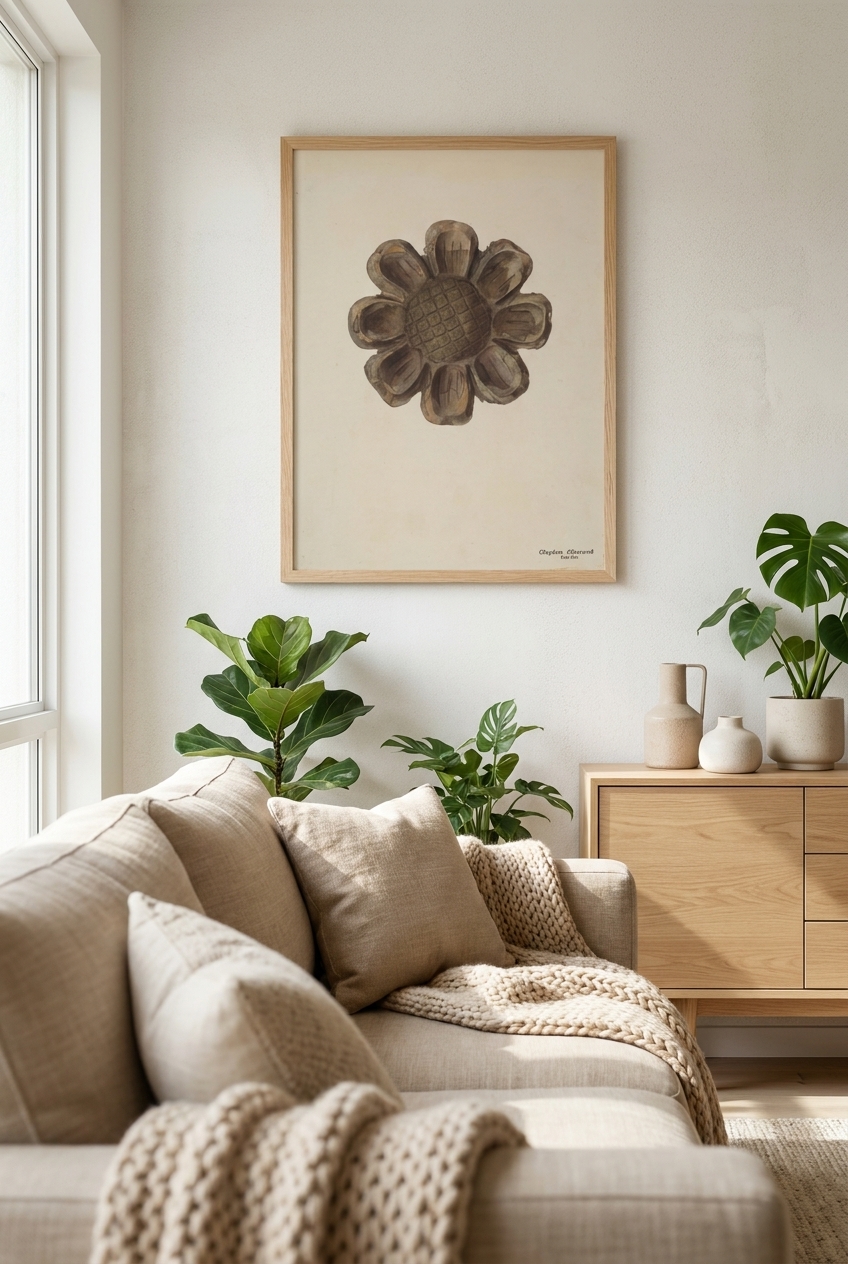
Take, for example, his stunning rendering of a Wood Carving - Flower from circa 1939. Here, the soft transitions from shadow to light create an extraordinary sense of atmospheric perspective. The flower seems to emerge from the page, suspended in a state of poetic stillness. This technique requires incredible patience and academic training, ensuring that every gradient of tone serves to ground the object in space, giving it a tactile quality you can almost feel.
Why Classical Balance Belongs on Modern Walls
In our fast-paced modern lives, our homes are meant to be sanctuaries. This is why the classical restraint of Clayton Clements's work translates so beautifully into contemporary interiors. Because his compositions are rooted in structural balance and ideal beauty, they bring an immediate sense of calm and order to any room they inhabit.
A high-quality fine-art print of his work acts as a visual anchor. Whether framed on a minimalist gallery wall or stretched as a textured canvas above a mid-century sideboard, these pieces offer a moment of quiet reflection. The neutral tones, clean lines, and soft play of light complement modern color palettes while adding a layer of historical depth and academic sophistication that never goes out of style.
Frequently asked questions
What artistic style does Clayton Clements's work represent?
Clements worked within the Classical tradition, which is characterized by a focus on ideal beauty, structural balance, academic rigor, and a harmonious representation of the natural world.
How does Clements use light in his compositions?
Rather than using light just for simple illumination, Clements treats light as a structural tool. Through careful tonal graduation and atmospheric perspective, his light defines the physical form of his subjects, creating a sense of three-dimensional depth and poetic stillness.
Why do these prints suit modern home decor?
Their clean lines, balanced compositions, and neutral, atmospheric tones make them incredibly versatile. They bring a sense of calm, order, and timeless sophistication to modern, minimalist, or traditional spaces alike.