
John Constable: Painting the Breath of the English Countryside
In short: John Constable rejected stiff, idealized landscapes to paint the living, breathing English countryside. His textured brushwork and mastery of light make his scenes of Suffolk and Salisbury timeless additions to any modern home.
The Poetry of the Everyday
John Constable did not care for the grand, imaginary landscapes popular in early nineteenth-century academies. While his contemporaries painted dramatic, idealized scenes of ancient Rome or mythical lands, Constable looked at the muddy banks of the River Stour in Suffolk and saw something worthy of high art. Born the son of a corn merchant, he grew up watching watermills, barges, and damp fields. He famously remarked that the sound of water escaping from mill-dams, old rotten planks, and slimy posts were things he loved deeply. He believed that a painter's own backyard, if observed with absolute fidelity, held more truth than any classical fantasy. This quiet revolution elevated the humble English countryside into a subject of profound emotional weight. By exploring the Full John Constable collection, one can see how this dedication to the local and the real transformed the history of landscape art forever.
Constable's Snow and the Living Sky
To capture the living, breathing world, Constable had to invent an entirely new visual language. He was obsessed with weather, light, and the shifting atmosphere. He spent hours "skying"—lying on his back on the Hampstead Heaths to sketch the rapid movement of clouds. To translate this fleeting energy onto canvas, he abandoned the smooth, polished surfaces favored by the art establishment. Instead, he used expressive, heavily textured brushwork and pioneered the use of outdoor oil sketching, capturing the immediate, visceral experience of nature on the spot. Most famously, he applied tiny, flicked highlights of pure white paint across his landscapes. Critics at the time mocked this technique, calling it Constable's snow. In reality, it was a stroke of impressionistic genius, perfectly capturing the shimmering quality of wet leaves, dew-soaked grass, and sunlight breaking through a sudden summer rain shower.
The Drama of Sky and Stone
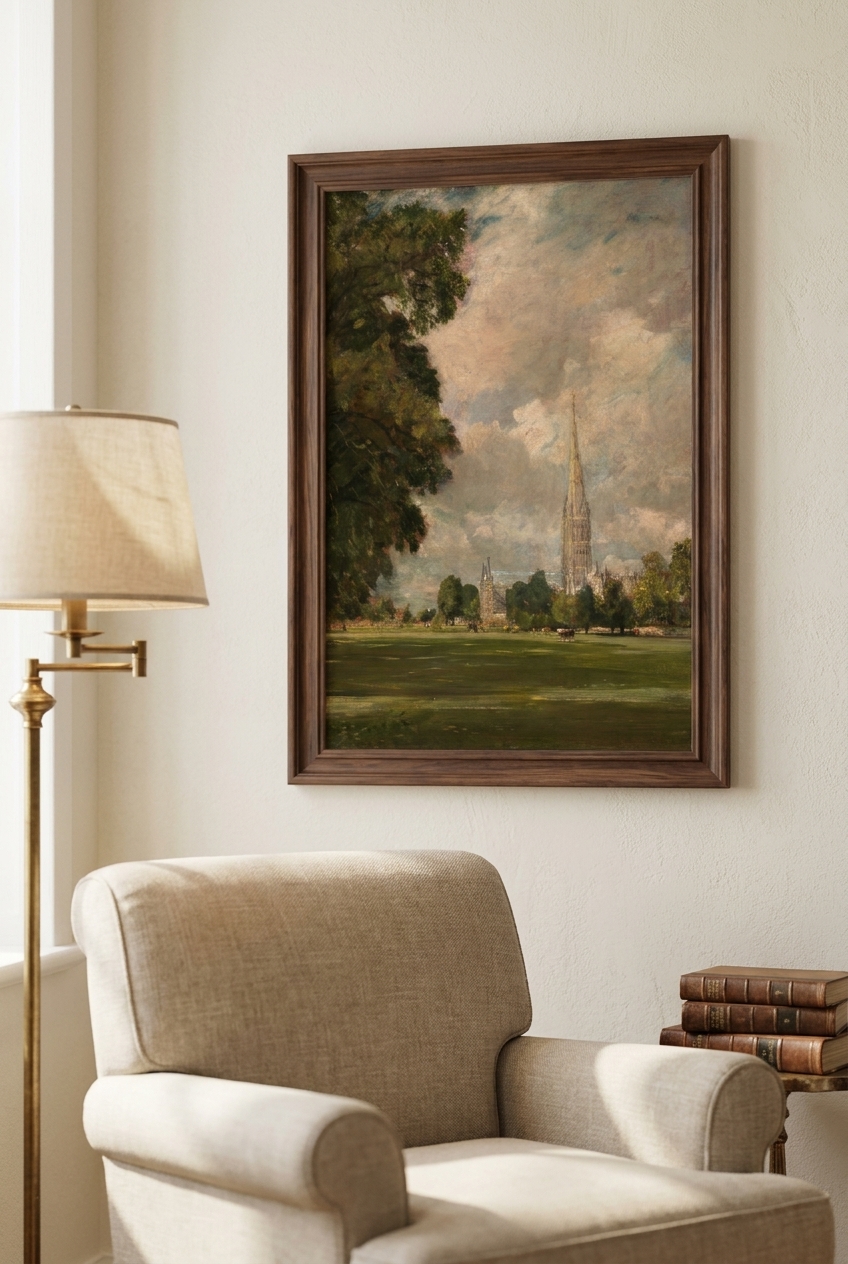
While Constable is beloved for his quiet rivers and rustic wagons, he was also a master of dramatic scale and architectural majesty. His relationship with Salisbury Cathedral yielded some of his most powerful and enduring compositions. In his masterpiece, Salisbury Cathedral from Lower Marsh Close, we see the perfect marriage of his two great strengths: the soaring, structured lines of gothic architecture and the wild, unpredictable forces of nature. The cathedral spire pierces a sky heavy with shifting, atmospheric clouds, framed by ancient trees that feel alive with motion. It is a masterclass in how Constable balanced academic structure with raw, emotional naturalism, capturing a fleeting moment of light and shadow that feels as immediate today as it did two centuries ago.
Why Constable Belongs in the Modern Home
There is a reason Constable’s landscapes feel so remarkably at home in contemporary living spaces. His color palette—dominated by rich, organic greens, deep ochres, and watery blues—brings an instant sense of warmth and natural grounding to a room. Unlike the flat, digital imagery that fills our daily lives, a Constable print offers incredible visual depth and texture. His paintings do not demand attention with loud, artificial colors; instead, they invite the viewer to slow down, breathe, and notice the quiet majesty of the natural world. Whether displayed as a large, sweeping canvas above a mantelpiece or as a framed print in a quiet study, his work acts as a window to a peaceful, elemental world.
Frequently asked questions
What makes John Constable's style unique?
Constable was a pioneer of naturalism, rejecting idealized classical landscapes in favor of direct, honest observation. He is famous for his expressive, textured brushwork, his extensive outdoor oil sketching, and 'Constable's snow'—the innovative use of white highlights to capture the shimmer of wet leaves and sunlight.
Did Constable paint his landscapes entirely outdoors?
While Constable was a pioneer of painting outdoors (en plein air), his large-scale exhibition canvases—often called his 'six-footers'—were painted in his studio. However, they were based on highly detailed, visceral oil sketches that he painted directly in the fields and meadows of the English countryside.
What was the inspiration behind his paintings of Salisbury Cathedral?
Constable visited Salisbury frequently to stay with his close friend, Archdeacon John Fisher. The cathedral and its surrounding marshy meadows became a recurring subject, allowing him to explore the dramatic interplay between permanent, man-made architecture and the ever-changing, fleeting effects of weather and light.