
The Alchemists of Gubbio: The Shimmering Art of Maestro Giorgio Andreoli
In short: The 16th-century workshop of Maestro Giorgio Andreoli of Gubbio elevated Renaissance ceramics to high art, using secret metallic luster glazes that shimmer with gold and ruby-red light.
The Alchemists of Gubbio
In the early sixteenth century, the small hill town of Gubbio in Umbria became the center of a quiet artistic revolution. Here, in the busy studio of Maestro Giorgio Andreoli, clay was transformed into something resembling pure magic. While other Renaissance workshops painted beautiful scenes on earthenware, Andreoli’s workshop did something more: they made them glow.
The workshop was famous across Europe for its absolute mastery of luster glazes—a highly secretive, temperamental chemistry that fused metallic oxides onto already-fired ceramics. Today, works from the Maestro Giorgio Andreoli of Gubbio collection are celebrated as the absolute pinnacle of Italian Renaissance majolica, blending classical narrative painting with an almost supernatural shimmer.
The Secret of the Ruby Glow
What made the Gubbio workshop so legendary was its exclusive command over two specific colors: an iridescent, fiery ruby-red and a warm, golden-yellow. These were not ordinary paints. They were metallic lusters applied in a third, extremely risky firing. The kiln's oxygen had to be choked back at just the right moment, forcing the smoke and carbon to draw oxygen out of the metallic salts, leaving behind a microscopically thin layer of pure metal fused to the glaze.
If the temperature was off by even a few degrees, or if the wood used for fuel was too damp, the entire batch would be ruined. But when it succeeded, the result was breathtaking. The surfaces caught the light with a dramatic, ethereal depth, turning everyday plates and bowls into high-status luxury goods coveted by dukes and popes.
Mythology and Motion in Clay
The workshop didn't just excel in chemistry; it was also a hub of brilliant storytelling. Painters in the circle of Maestro Giorgio depicted complex classical myths, historical battles, and biblical scenes, often adapted from popular engravings of the day. The metallic luster was applied selectively, highlighting a drapery fold, a sunset, or a shield, giving the flat scenes a surprising sense of movement.
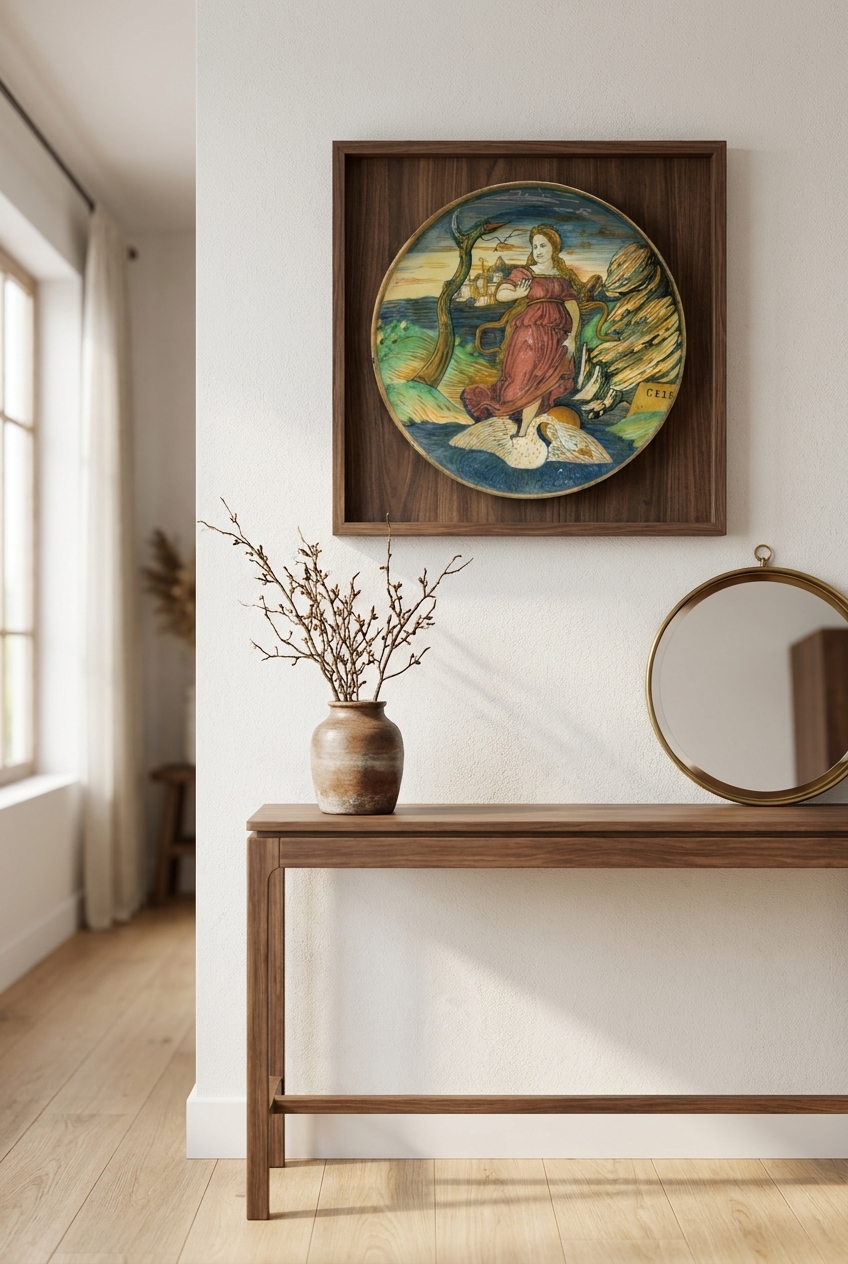
A perfect example of this narrative flair is the shallow bowl on low foot with the muse Clio riding on a swan. In this piece, the watery landscape and the elegant figure of the muse are brought to life with delicate linework and illuminated by those signature metallic flashes, creating a scene that feels suspended between the earthly and the divine.
A Renaissance Spark for the Modern Home
While the original ceramic plates are safely guarded behind museum glass, their visual power translates beautifully into high-quality fine-art prints and canvases. The rich, earthy tones of Renaissance majolica—deep cobalt blues, warm ochres, and leafy greens—provide a sophisticated, grounded color palette for contemporary interiors.
When printed on archival paper or canvas, the intricate details of the brushwork and the illusion of the shimmering luster are captured with stunning clarity. Hanging one of these pieces in a modern room brings a touch of old-world alchemy, a conversation starter that bridges the gap between ancient craftsmanship and modern design.
Frequently asked questions
What is majolica?
Majolica (or maiolica) is a style of Italian tin-glazed earthenware popular during the Renaissance. It is characterized by its bright, colorful painted designs on a white background, which is achieved by coating the clay with a lead glaze containing tin oxide.
Why is the luster technique so famous?
Lusterware was highly prized because it was incredibly difficult to produce. It required a third firing in a reduction kiln (where oxygen is restricted), using a secret recipe of copper and silver oxides to create a metallic, iridescent sheen that shimmered in candlelight.
How do these ceramic designs translate to flat art prints?
Our high-resolution prints capture the incredible texture, brushwork, and depth of the original three-dimensional ceramic pieces. The rich colors and the visual illusion of the metallic luster are preserved in crisp detail, offering a unique, historical aesthetic for your walls.