
The Alchemy of Ink and Light: Turner, Say, and the Art of the Sublime
In short: J.M.W. Turner's revolutionary vision of light and atmosphere met its perfect match in William Say's mastery of mezzotint, creating dramatic, velvety prints that bring the Romantic sublime into modern interiors.
The Painter and the Printmaker
In the early nineteenth century, Joseph Mallord William Turner was busy redefining what a landscape could be. While his contemporaries painted neat, orderly views of the countryside, Turner chased the untamable. He painted blinding sunbursts, swirling vortexes of snow, and the terrifying, beautiful chaos of the sea. But Turner faced a challenge: how could he share these fleeting, atmospheric visions with a wider public without losing their poetic soul?
The answer lay in an extraordinary partnership with the master engraver William Say. Together, they bridged the gap between painting and printmaking, translating Turner's revolutionary obsession with light into a medium of astonishing tonal depth. Through their collaboration, which you can explore in the Full Joseph Mallord William Turner and William Say collection, the temporary dramas of nature were given permanent, velvety form.
The Magic of Mezzotint
To understand why these prints are so arresting, one must understand the technique behind them. William Say was a pioneer of the mezzotint process, a printmaking method that works from dark to light. Unlike traditional line engraving, which relies on sharp, incised lines, mezzotint begins by roughening a copper plate with a heavy, textured tool called a rocker. If inked at this stage, the plate would print as a solid, rich black.
To create an image, Say had to scrape and burnish the metal back down, smoothing out the roughness to create lighter tones. This subtractive process was incredibly labor-intensive, but it allowed for an unprecedented range of texture, shadow, and soft gradation. It was the perfect match for Turner's fluid, painterly style. Say could mimic the soft curl of mist, the heavy dampness of storm clouds, and the brilliant, sudden burst of sunlight breaking through a canopy with a warmth and richness that line engraving could never hope to achieve.
What to Look For: Storms, Seas, and Shadows
When you look at a Turner and Say print, your eyes are immediately drawn to the extremes of light and shadow. This is Classical Romanticism at its most potent—an art movement dedicated to evoking the "sublime," that thrilling mix of awe and terror we feel when confronted by the vastness of nature.
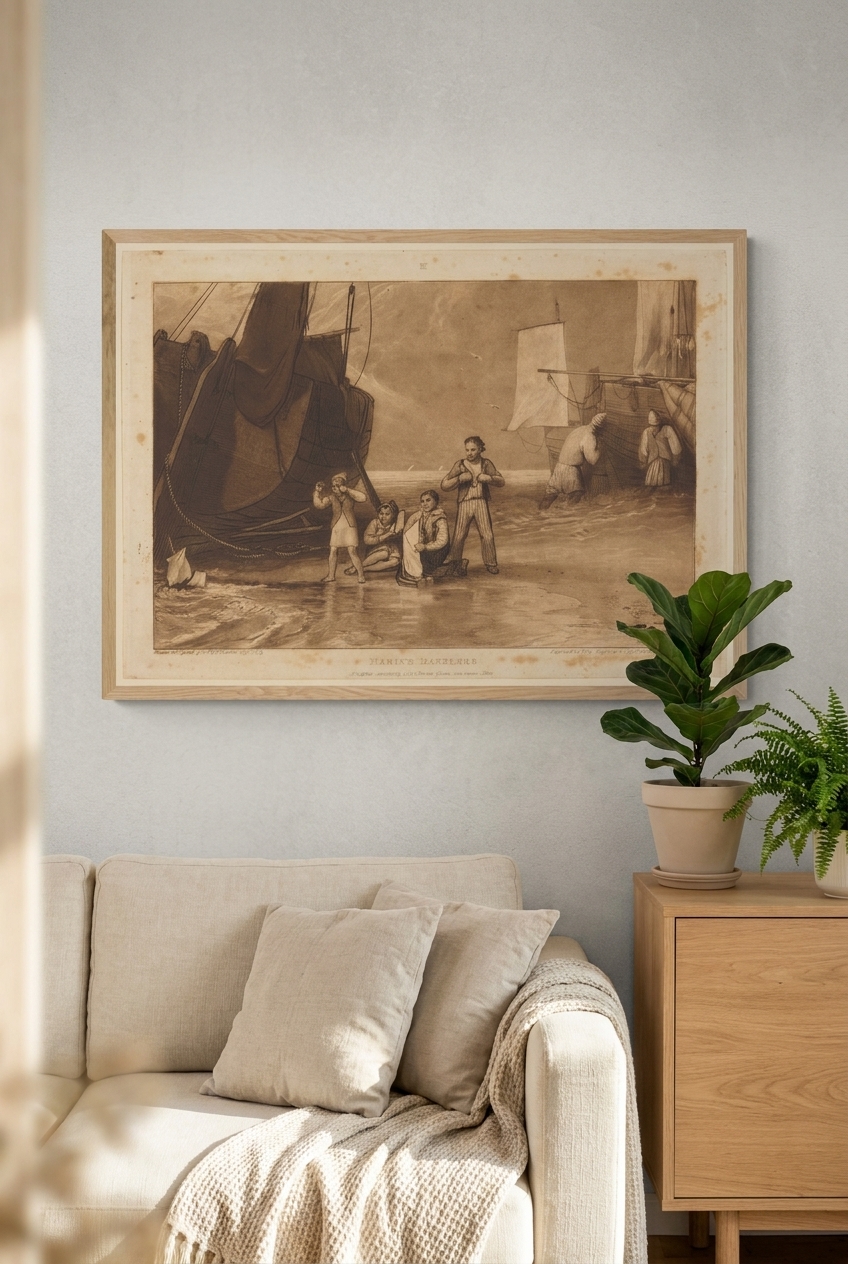
Yet, they also captured quieter, more intimate moments of human life set against these grand backdrops. A wonderful example is Marine Dabblers, published in 1811. In this piece, we see children playing by the shore alongside fishing boats. The composition is a masterclass in texture: the damp sheen of the tidal mud, the heavy timber of the vessels, and the soft, expansive sky overhead. It shows how the duo could find poetry not just in mountain peaks and shipwrecks, but in the simple, daily rhythms of the coast.
Bringing the Romantic Sublime into the Modern Home
There is a common misconception that nineteenth-century prints belong only in traditional, wood-paneled libraries. In truth, the dramatic contrast and rich textures of Turner and Say's work make them exceptionally well-suited for modern, minimalist, or industrial interiors.
Because these pieces rely on a sophisticated palette of deep blacks, velvety grays, and warm ivory tones, they act as elegant anchors in a room. They offer a sense of history and depth without clashing with contemporary color schemes. Framed simply, a high-quality reproduction of their work brings a sense of quiet drama and intellectual curiosity to a space, inviting guests to step closer and lose themselves in the swirling mists and glowing horizons of a bygone era.
Frequently asked questions
What makes a mezzotint print different from a standard etching or engraving?
While etchings and standard engravings rely on lines to build up an image, mezzotint is a tonal process. The artist works from dark to light by smoothing down a pre-roughened metal plate. This creates incredibly soft gradations of tone and rich, velvety blacks that are impossible to achieve with lines alone, making it ideal for reproducing the soft textures of clouds, water, and light.
Why is J.M.W. Turner associated with "Classical Romanticism"?
Romanticism was an artistic movement that prioritized emotion, imagination, and the awe-inspiring power of nature over cold reason. Turner is a key figure because his landscapes do not just document a place; they capture the emotional experience of being there. His "classical" sensibility refers to his deep appreciation for historical compositions and the timeless, elemental forces of the world.
How do these prints look when reproduced on modern materials like canvas?
Because William Say's engraving technique relied heavily on texture and deep, velvety shadows, these works translate beautifully to modern archival papers and canvases. The subtle weave of canvas enhances the tactile feel of the original mezzotint, while high-quality fine-art papers preserve the crispness of the lighter highlights and the deep, rich blacks.