The Architectural Soul of Louis Conrad Rosenberg
In short: Louis Conrad Rosenberg combined his training as an architect with the delicate art of etching, creating masterfully detailed prints of European ruins and cathedrals that bring timeless, structured elegance to modern walls.
The Architect's Eye
There is a profound difference between drawing a building and understanding how it stands. Louis Conrad Rosenberg belonged to that rare breed of artists who began their journey not in the life-drawing studio, but at the drafting table. Trained as an architect, Rosenberg brought a rigorous, structural authority to the art of printmaking. When you look at his depictions of historic European landscapes, you do not just see facades; you feel the immense weight of the stone, the engineering of the arches, and the deliberate geometry of classical design.
Active during the height of the Classical Revival, Rosenberg traveled extensively through Europe, capturing the monumental grandeur of antiquity. His work stands as a masterclass in architectural etching, transforming cold stone into something deeply poetic. For those drawn to the quiet beauty of historic cities, exploring the Full Louis Conrad Rosenberg collection reveals an artist obsessed with the bones of our built world.
The Magic of Needle and Acid
What sets Rosenberg apart from mere technical draftsmen is the exquisite tension in his work between scientific precision and atmospheric depth. Etching is a brutal yet delicate medium. It requires drawing with a fine needle onto a wax-coated metal plate, which is then bathed in acid to bite the lines into the copper. Rosenberg was a master of this process. Through controlled tonal biting, he could conjure the rough, sun-baked texture of Roman ruins or the damp, soaring vaults of Gothic cathedrals.
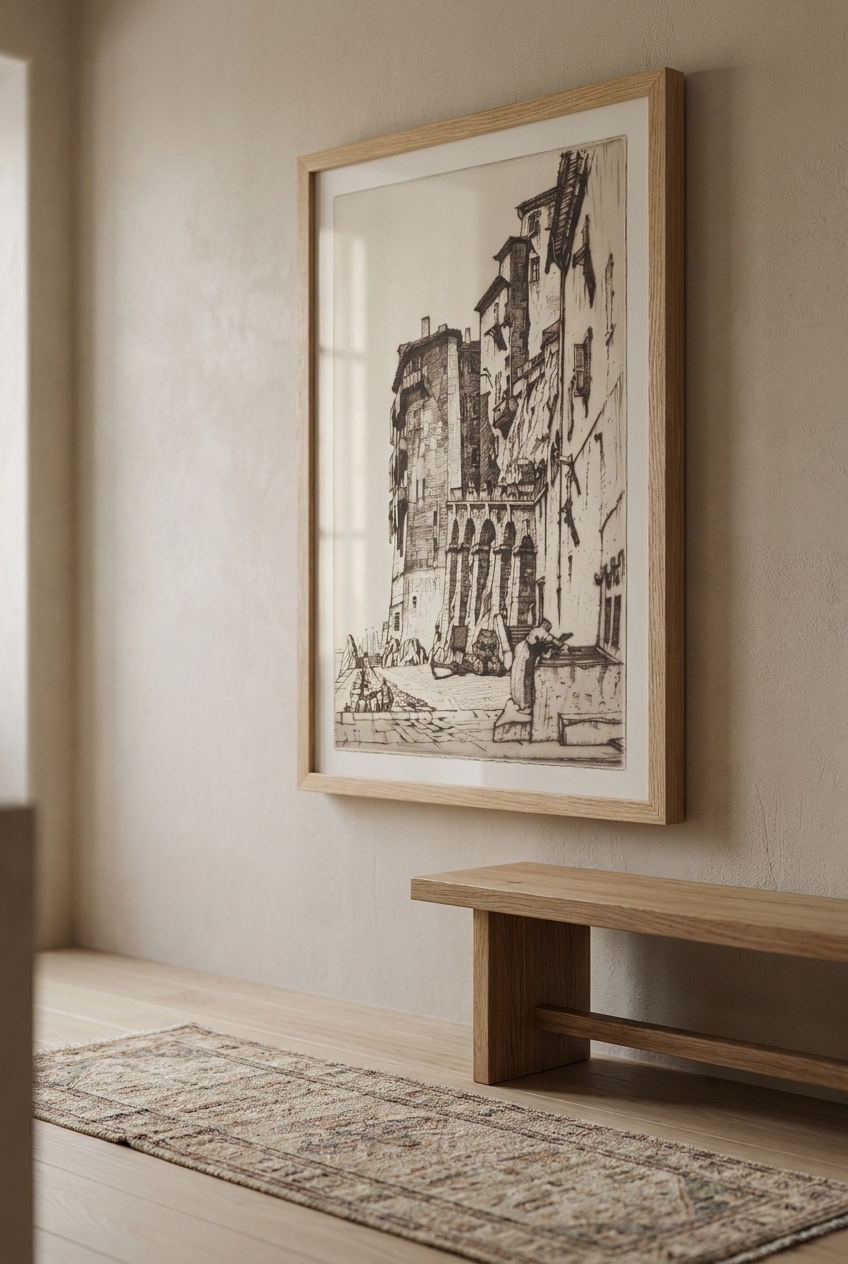
His prints are alive with the passage of time. He had an extraordinary sensitivity to how light rakes across weathered stone, casting long, dramatic shadows that tell a story of centuries gone by. In pieces like Quai de la Marine, Villefranche (1928), we see how he could shift from monumental ruins to the intimate, sun-drenched corners of European coastal life, always maintaining that flawless balance of structural truth and luminous atmosphere.
Timeless Structure for Modern Spaces
In modern interior design, where clean lines and minimalist aesthetics often dominate, Rosenberg's etchings offer a perfect counterpoint. They bring a sense of history, intellect, and quiet drama to a room without overwhelming it. Because his works are primarily monochromatic, they integrate seamlessly into almost any color palette, offering a sophisticated focal point that invites closer inspection.
A high-quality print of Rosenberg's work functions like a window into another era. Framed on a study wall or hung above a living room mantle, these pieces ground a space. They remind us of the enduring beauty of human craftsmanship, making them the perfect addition for anyone who values both classic architecture and the fine art of printmaking.
Frequently asked questions
What is "tonal biting" in etching?
Tonal biting is a printmaking technique where the artist controls how long different parts of an etched plate are exposed to acid. Longer exposure creates deeper, wider grooves that hold more ink, resulting in richer, darker shadows, while shorter exposure yields delicate, light lines. Rosenberg used this to create his signature atmospheric depth.
What makes Classical Revival art unique?
Classical Revival art and architecture draw inspiration from the symmetry, proportion, and monumental grandeur of ancient Rome and Greece. In Rosenberg's work, this manifests as a deep appreciation for classical ruins, balanced compositions, and a focus on structural harmony.
How do Rosenberg's architectural prints fit into modern home decor?
Because of their fine detail, neutral monochromatic tones, and strong geometric compositions, Rosenberg's prints bring a sense of structure and intellectual depth to modern spaces. They pair beautifully with minimalist, mid-century, or traditional decor, acting as sophisticated, grounding elements.