
The Classical Order of Folk Art: Spotlighting Frances Lichten
In short: Frances Lichten's precise, elegant illustrations of early American crafts bridge the gap between historical preservation and fine art, making her work a perfect fit for modern, thoughtful homes.
The Art of Quiet Preservation
Frances Lichten did not paint grand, sweeping historical battles or dramatic landscapes. Instead, she found her muse in the quiet, enduring beauty of early American craftsmanship. Working within the refined lineage of classical draftsmanship, Lichten dedicated her career to capturing the structural harmony of regional decorative traditions. She understood that a handmade clay pot or a hand-woven coverlet carried the same dignity and balance as a classical Greek column.
During the 1930s, as part of the Federal Art Project, Lichten became a key figure in documenting America's visual heritage. She did not just record these objects; she studied their soul, capturing the quiet dignity of classical motifs that crossed oceans and settled in early American communities. Through her precise illustrations, she bridged the gap between archival documentation and fine art, giving historical objects a second life on paper.
The Symmetrical Soul of Folk Art
At first glance, folk art might seem rustic or casual. But under Lichten's watchful eye, these regional designs reveal a deep, classical order. Her stylistic signature is defined by an exacting precision. She used clean lines and balanced compositions to elevate humble designs into timeless statements of symmetry. In her work, a simple floral motif becomes a masterclass in geometry.
Her process was painstaking. She worked primarily in watercolor and ink, rendering textures with such fidelity that you can almost feel the cold slip-glaze of the pottery or the rough grain of the hand-carved wood. By using a delicate handling of form and a restrained, earthy palette, she honored the enduring beauty of historical craftsmanship, translating heritage into works of serene order. You can explore this unique balance of history and design in the full Frances Lichten collection.
Spotlighting a Masterpiece: The Flower Holder
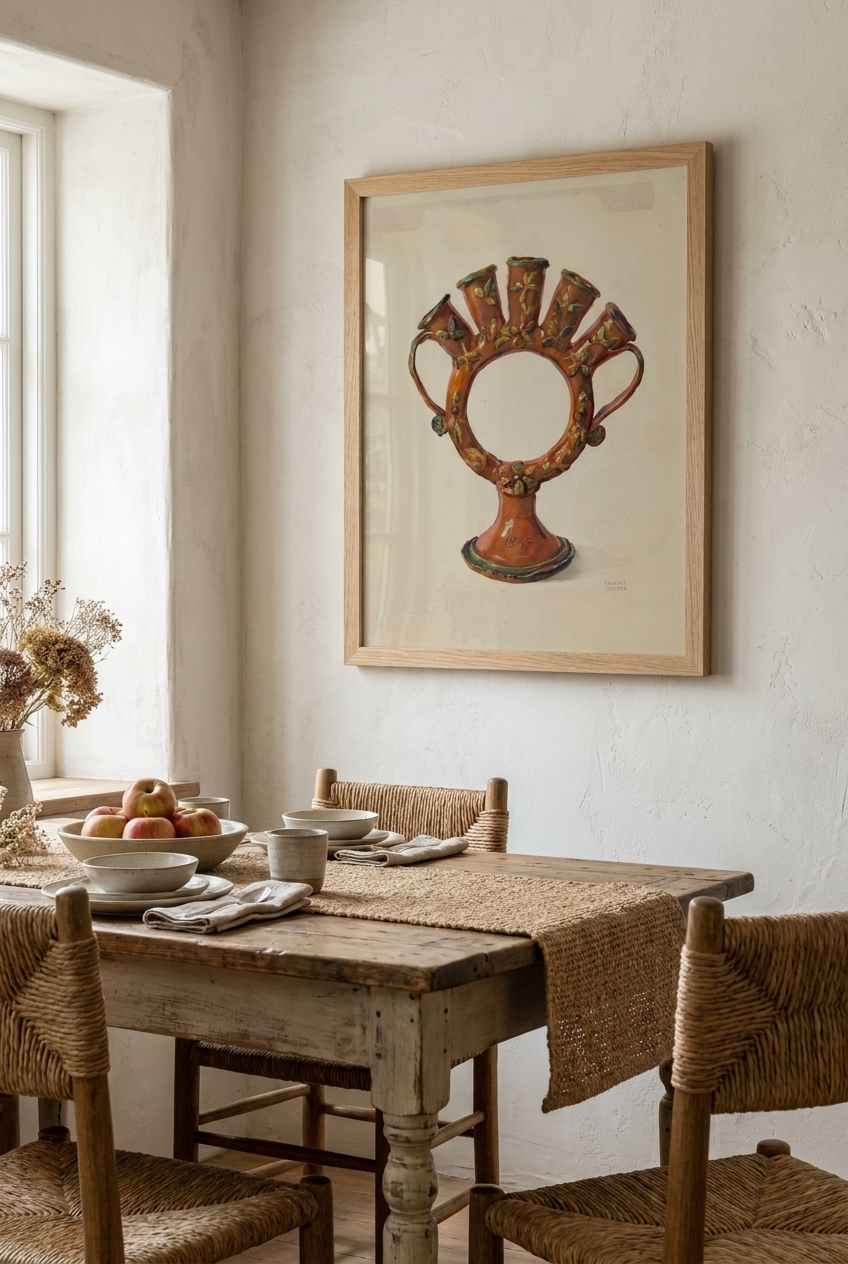
One of the most striking examples of her ability to elevate the everyday is her rendering of a Pa. German Flower Holder from around 1936. In this work, the rustic earthenware vessel is treated with the reverence of an ancient artifact. The symmetry of the double-tiered holder, adorned with stylized birds and delicate flora, showcases her incredible draftsmanship.
Lichten captures the texture of the glaze, the weight of the clay, and the whimsical charm of the folk motifs, all while maintaining a crisp, clean clarity that feels remarkably modern. It is a piece that feels alive with the spirit of the anonymous artisan who first shaped the clay, preserved forever through Lichten's meticulous brush.
Why Her Work Belongs in the Modern Home
Lichten's prints offer a rare quality for contemporary interiors: they are rich with history yet visually uncluttered. Because she focused on clean lines and balanced compositions, her pieces fit effortlessly into modern spaces. Whether hung in a minimalist living room or a cozy kitchen, her work brings a sense of warmth, authenticity, and quiet contemplation.
In a world of mass-produced decor, Lichten's work stands out as an homage to the human hand. A high-quality print of her work acts as an anchor in a room, offering a soothing focal point that celebrates craftsmanship, heritage, and the timeless appeal of classical symmetry. They are not merely decorative; they are conversations with the past, preserved with the utmost care.
Frequently asked questions
Who was Frances Lichten?
Frances Lichten (1889–1961) was an American artist, illustrator, and archivist. She is best known for her work with the Index of American Design, a New Deal project where she meticulously documented early American folk art and crafts, particularly those of the Pennsylvania Germans.
What makes her style unique?
Lichten's style combines the precision of technical illustration with the warmth of fine art. She used clean lines, balanced compositions, and a restrained palette to emphasize the classical symmetry and structural harmony of everyday historical objects.
How do Frances Lichten prints fit into modern home decor?
Because of her focus on clean lines, balanced compositions, and earthy, neutral color palettes, her prints bridge the gap between rustic charm and modern minimalism. They add historical depth and warmth to contemporary spaces without feeling dated or busy.