
The Dawn of Perspective: The Quiet Magic of 15th-Century Florence
In short: In 15th-century Florence, workshop masters revolutionized art by blending scientific perspective with human emotion, creating balanced, serene masterpieces that bring classical elegance to modern walls.
The Cradle of the Renaissance
In the winding, stone-paved streets of fifteenth-century Florence, a quiet revolution took place. It wasn't just a political shift, but a profound transformation in how human beings saw themselves and the world around them. This was the dawn of the Early Renaissance, an era where the rigid, flat gold backgrounds of medieval devotion gave way to the breathing, three-dimensional reality of humanism. While we often celebrate a few legendary names, much of this artistic rebirth was fueled by the collective genius of anonymous masters and collaborative workshops. Today, the Florentine 15th Century collection represents a golden age of intellectual curiosity and artistic mastery.
These artists did not just paint; they observed. They studied the natural world, the drape of heavy fabric, the play of light on skin, and the mathematical laws of space. By marrying scientific observation with deep spiritual devotion, they created a visual language that feels both incredibly grounded and wonderfully transcendent.
The Geometry of Grace
When you look at a Florentine painting from this period, you are looking at a masterclass in balance and restraint. Unlike the dramatic, high-contrast theatricality of later art movements, the Early Renaissance favored a serene, measured order. Artists of this era pioneered linear perspective, using mathematical grids to draw the viewer's eye deep into the canvas. This architectural precision gives each composition a remarkable sense of stability and calm.
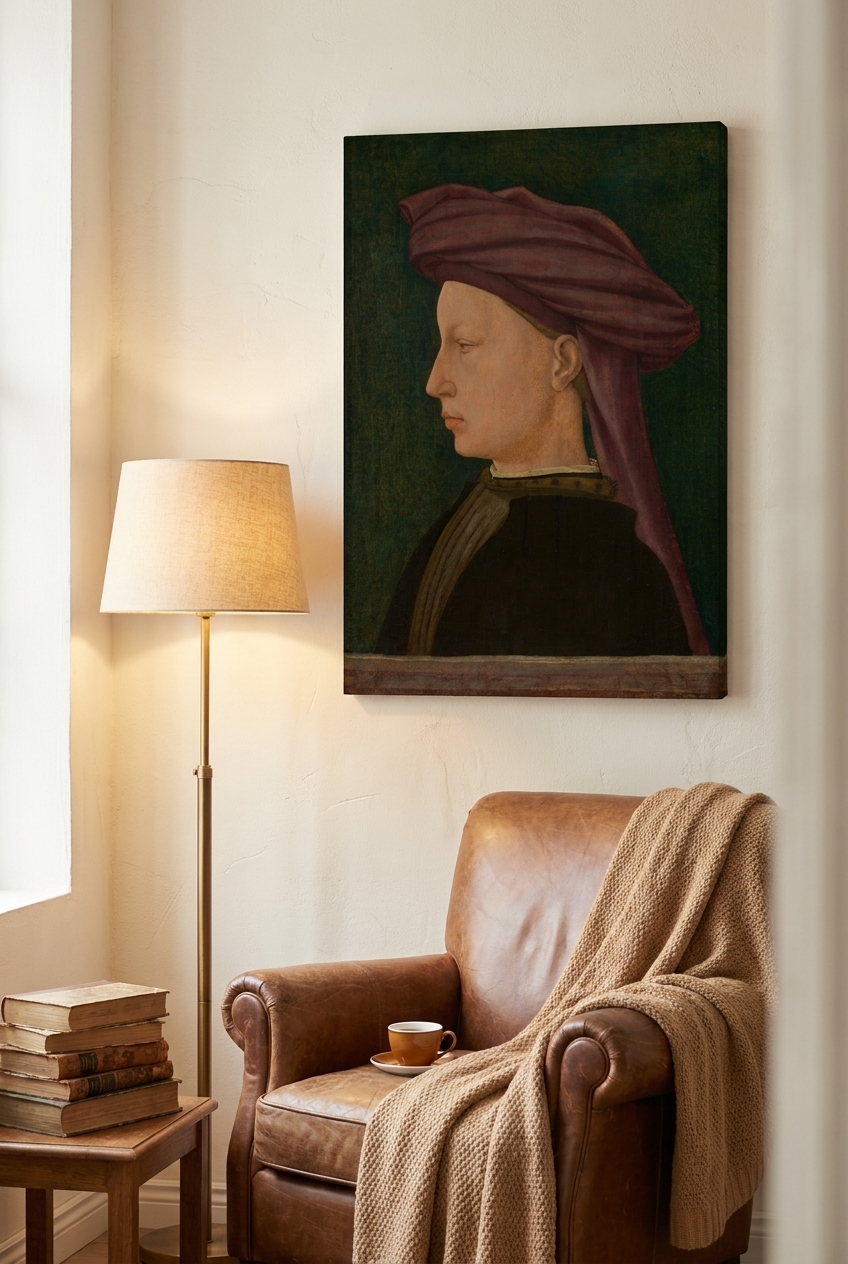
Beyond perspective, look closely at the figures. You will find elegant, rhythmic drapery that clings naturally to the body, revealing anatomical precision beneath. The palette is typically restrained, relying on soft, earthy pigments, chalky ochres, and deep, quiet blues. A perfect example of this refined sensibility is the Profile Portrait of a Young Man, which captures the era's obsession with classical symmetry, crisp linework, and dignified human character.
Bringing the Florentine Spirit Home
There is a unique magic in placing a fifteenth-century Florentine reproduction in a modern home. Modern interiors often thrive on clean lines, neutral colors, and open spaces. The inherent geometry and balanced compositions of Early Renaissance art complement these contemporary design choices perfectly. They offer a sense of structural harmony that grounds a room.
Furthermore, these pieces carry an intellectual weight and a sense of history that mass-produced modern art simply cannot replicate. Whether printed on textured canvas to highlight the soft, fresco-like qualities of the paint, or framed behind glass to emphasize the crisp precision of the linework, these works bring a quiet, scholarly elegance to any living space. They invite quiet contemplation, serving as windows into an era that redefined the human experience.
Frequently asked questions
Why are many of these 15th-century Florentine works unattributed to a single artist?
In the 15th century, art was highly collaborative. Master artists ran busy workshops where apprentices, assistants, and specialists worked together on a single commission. Often, the workshop itself was the 'brand,' leaving many exquisite pieces anonymous to modern eyes.
What makes linear perspective so important in these paintings?
Linear perspective was a groundbreaking mathematical system developed in Florence that allowed artists to create the illusion of three-dimensional depth on a flat surface. It gave paintings a sense of real, physical space and architectural order.
How do these classical prints fit into contemporary interior design?
Their balanced compositions, architectural symmetry, and soft, naturalistic color palettes act as visual anchors. They bring a sense of history, quiet intelligence, and calm to modern, minimalist, or eclectic spaces without overwhelming the room.