The Dramatic Collision of Light and Land: Tintoretto and Maarten de Vos
In short: When Venetian drama met Flemish precision, magic happened. The collaboration between Jacopo Tintoretto and Maarten de Vos brings theatrical light and vast, atmospheric landscapes together in a way that elevates any modern space.
Two Worlds, One Canvas
In the bustling art world of the late sixteenth century, Venice and Antwerp were two of Europe’s most vibrant creative engines. One was a city of shimmering canals, golden light, and operatic drama; the other, a northern powerhouse of meticulous detail, printmaking, and expansive, atmospheric vistas. When the paths of Venetian master Jacopo Tintoretto and Flemish painter Maarten de Vos crossed, the result was a spectacular artistic dialogue that bridged these two distinct worlds.
This rare partnership combined Tintoretto’s fluid, muscular figuration with De Vos’s structured, receding landscapes. It was a meeting of minds that challenged the traditional boundaries of Renaissance art, blending Italian theatricality with Northern European precision. To explore this unique artistic alliance, you can view the Full Jacopo Tintoretto, with landscape by Maarten de Vos collection.
The Energy of Tintoretto, the Depth of De Vos
Jacopo Tintoretto was known to his contemporaries as Il Furioso (The Furious One) because of his phenomenal speed and the wild, passionate energy of his brushwork. He didn't just paint figures; he sculpted them with light, casting deep shadows and brilliant highlights to create a sense of urgent, unfolding drama. His characters always seem caught mid-motion, suspended in moments of high spiritual or emotional intensity. The Venetian school excelled in this warm, sensory approach, prioritizing color and emotion over rigid drawing.
But a great drama needs a stage. Enter Maarten de Vos, a master of Northern Mannerism who had traveled south to study the Italian masters. De Vos brought a cool, intellectual structure to the collaboration. Where Tintoretto’s brush was quick and expressive, De Vos’s hand was patient and precise. He constructed landscapes that draw the eye deep into the background through a series of carefully planned, receding planes—winding rivers, distant blue mountains, and atmospheric skies that feel alive with cool, northern air. This created a perfect counterpoint to Tintoretto's fiery, immediate figures.
A Masterpiece of Collaboration
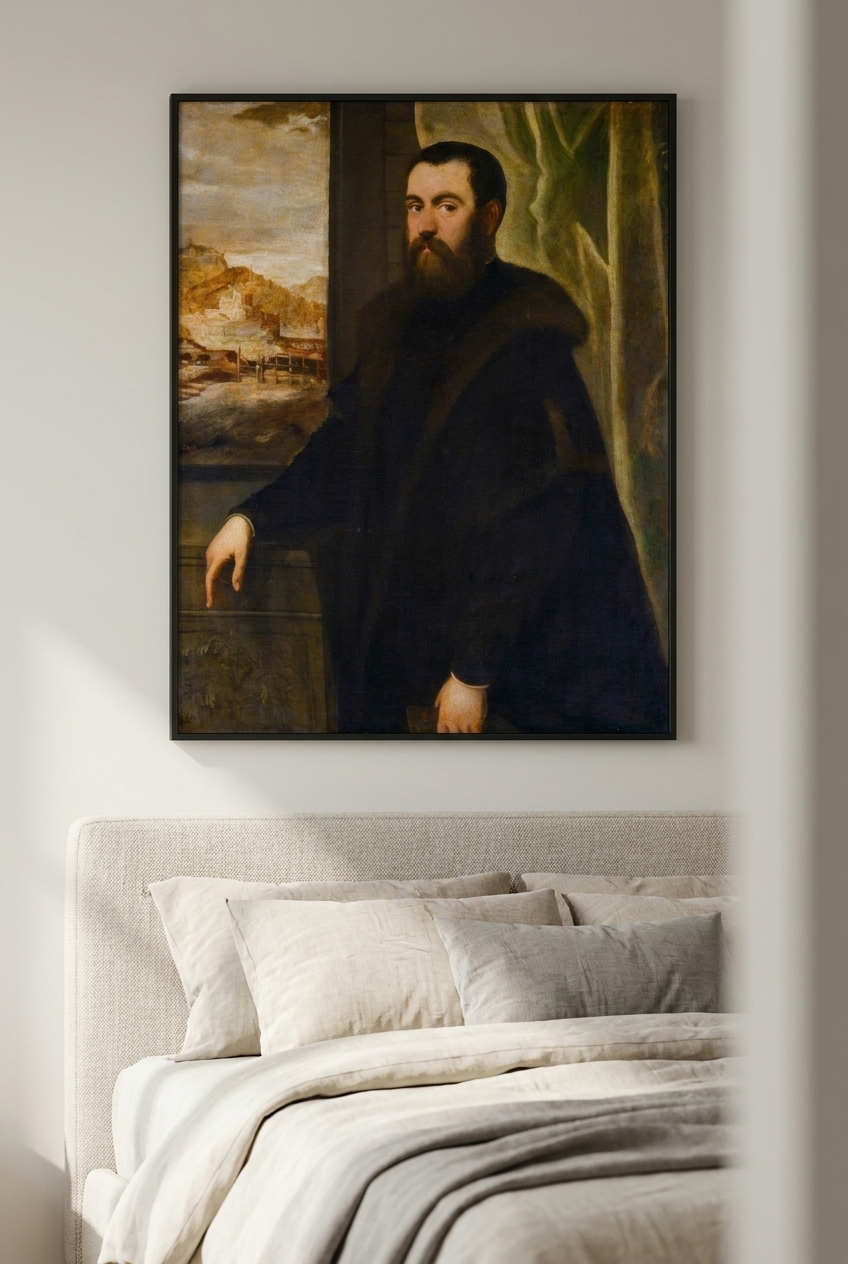
A stunning example of this cross-alpine synergy can be seen in the Portrait of a Man with a Landscape View. In this piece, the subject is rendered with the psychological depth and painterly freedom characteristic of Tintoretto’s finest portraits. The subject's gaze is direct and contemplative, captured with rapid, confident strokes that suggest a living, breathing presence. Yet, the window to the side opens up to a breathtaking, meticulously detailed landscape that bears the unmistakable touch of De Vos’s Flemish training.
This combination creates a fascinating tension. The figure feels immediate, warm, and intensely human, while the world outside feels vast, eternal, and coolly observed. It captures the intellectual curiosity of the late Renaissance, where humanity was constantly trying to find its place within the grander scheme of the natural world. Instead of competing for attention, the figure and the landscape elevate one another, creating a balanced, harmonious composition.
Why Their Work Belongs in the Modern Home
There is a timeless, cinematic quality to these collaborative works that makes them remarkably well-suited for contemporary interiors. The dramatic play of light and shadow—known as chiaroscuro—creates an instant focal point in any room, drawing the eye and setting a sophisticated, contemplative mood. The contrast between the warm, earthy tones of the figures and the cool, atmospheric blues and greens of the landscapes offers a versatile color palette that complements both modern and traditional decor.
When reproduced as high-quality fine-art prints or stretched canvases, the rich textures of Tintoretto's brushwork and the delicate gradients of De Vos's skies are preserved with stunning clarity. These pieces work beautifully in rooms with minimalist decor, where their rich, moody tones and deep perspectives can act as a visual window that expands the space. Whether framed in classic dark wood to emphasize the Renaissance drama or displayed as a clean, gallery-wrapped canvas, these works bring a layer of historical depth and intellectual intrigue to modern living spaces.
Frequently asked questions
Did Tintoretto and Maarten de Vos actually paint on the same canvases?
Yes. During the mid-16th century, Maarten de Vos traveled to Italy and spent time in Venice, where he worked as a journeyman in Tintoretto’s busy workshop. It was common practice for specialists to paint specific elements, and De Vos’s talent for landscape design was highly valued by Tintoretto.
What is Northern Mannerism, and how does it differ from the Italian Renaissance?
While the Italian Renaissance focused heavily on idealized human anatomy, perspective, and classical harmony, Northern Mannerism (originating in Flanders and Germany) emphasized intricate detail, elongated figures, and highly atmospheric, structured landscapes. The collaboration between Tintoretto and De Vos beautifully fuses these two distinct traditions.
How do these dark, dramatic Renaissance prints look in a modern, brightly lit room?
Surprisingly well. The high contrast of Tintoretto's chiaroscuro style prevents the artwork from looking muddy, even in bright spaces. In fact, natural light can highlight the subtle textures of the brushwork and the deep, receding blues of the Flemish landscape.