
The Featherlight Brush of Thomas Gainsborough
In short: Thomas Gainsborough revolutionized 18th-century British art by blending the elegance of high-society portraiture with a deep, personal love for the rustic English countryside, all rendered with a famously light, energetic brushstroke.
The Rebel of the English Golden Age
In the bustling, status-conscious world of eighteenth-century England, Thomas Gainsborough was a rare spirit. While his contemporaries labored to produce stiff, highly polished portraits that flattered the egos of the aristocracy, Gainsborough painted with a quicksilver energy. He was a man divided: his wealthy patrons demanded grand portraits, but his heart belonged entirely to the quiet, muddy lanes and rolling hills of the English countryside.
This creative tension defined his career. Gainsborough helped shape the golden age of British art, but he did so on his own terms. He famously complained that portraiture was his "common business," while landscape painting was his true love. Today, we see that this struggle produced some of the most vibrant, emotionally resonant art of his era. You can explore his range in our Full Thomas Gainsborough collection, which captures both his high-society elegance and his rustic escapes.
The Magic of the Featherlight Stroke
What makes a Gainsborough painting instantly recognizable is his technique. If you stand close to one of his canvases, the image seems to dissolve into a flurry of quick, sketchy marks. He rejected the smooth, enamel-like finishes favored by the academic establishment of his day. Instead, he used incredibly long brushes to apply paint in thin, translucent washes and rapid, "featherlight" strokes.
This approach was revolutionary. Rather than drawing static figures, Gainsborough captured movement and atmosphere. His brushstrokes mimic the rustle of silk gowns, the shimmering play of light through forest leaves, and the fleeting, warm expressions of his sitters. He did not just paint what he saw; he painted the air around his subjects, giving his work a breathing, luminous quality that feels remarkably modern.
From High Society to Wild Horizons
Though he made his fortune painting the rich and famous, Gainsborough’s landscapes are where his poetic soul truly shines. He often composed these scenes in his studio at night, arranging coal, dried herbs, and pieces of mirror on a table to model the rugged terrain of his imagination. These were not literal topographical records, but romantic dreams of rural peace.
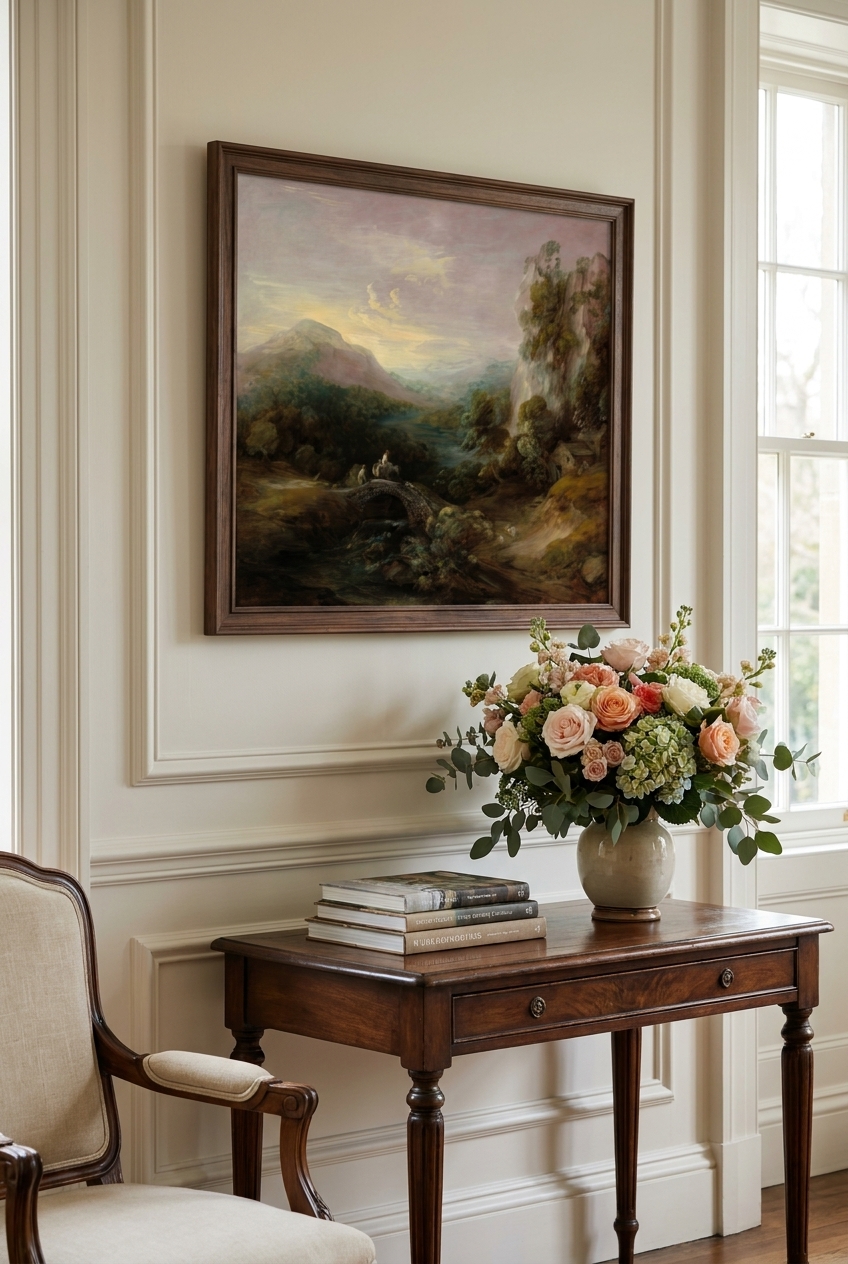
A perfect example of this atmospheric genius is his "Mountain Landscape with Bridge" (c. 1783/1784). In this piece, the dramatic cliffs, soft mist, and rustic travelers are bathed in a warm, golden glow. It is a masterclass in how Gainsborough used light to evoke a sense of deep, nostalgic longing for the natural world.
Why Gainsborough Belongs in the Modern Home
Gainsborough’s art possesses a unique versatility that makes it beautifully suited for contemporary living spaces. His color palette—dominated by soft forest greens, earth tones, luminous silvers, and sky blues—brings a calming, organic presence to a room. Unlike the heavy, dark oil paintings of some of his peers, Gainsborough’s works are filled with light and breath.
On a high-quality archival canvas or framed paper print, his loose, suggestive brushwork takes on a tactile, almost abstract quality when viewed up close. Whether hung in a minimalist living room to introduce a touch of classical warmth, or placed in a cozy study to evoke the quiet charm of the English countryside, his pieces offer a timeless window into nature and human grace.
Frequently asked questions
What is "Grand Manner" portraiture, and how did Gainsborough fit into it?
Grand Manner was a high-status style of 18th-century portraiture designed to look noble, classical, and elite. While Gainsborough painted the same wealthy clients as his rivals, he subverted the style by giving his sitters a relaxed, informal grace and placing them in wild, natural landscapes rather than rigid, artificial studio settings.
Did Gainsborough paint his landscapes outdoors?
No, Gainsborough rarely painted his finished landscapes directly from nature. Instead, he made sketches outdoors and then constructed miniature model landscapes in his studio using rocks, moss, coal, and glass to study the effects of light and shadow before transferring the scene to canvas.
How do Gainsborough's colors translate to modern fine-art prints?
Remarkably well. Because Gainsborough painted with thin, luminous glazes and a palette of soft blues, greens, and warm earth tones, modern giclée printing on archival paper or canvas beautifully captures the delicate transparency and airy depth of his original oil paintings.