
The Glowing Worlds of Giovanni d'Alemagna
In short: Active in 15th-century Venice, Giovanni d'Alemagna fused Northern precision with Italian lyricism, creating richly gilded, tapestry-like altarpieces that bridge the Gothic and Renaissance worlds.
The Bridge Between Two Worlds
In the mid-fifteenth century, Venice was a city floating between medieval fantasy and Renaissance clarity. Before the famous Bellini family came to dominate the local art scene, a quiet revolution was taking place in the workshop of Giovanni d'Alemagna and his close collaborator, Antonio Vivarini. Giovanni, whose name strongly suggests a Northern European origin, brought a distinct, meticulous sensibility to the Venetian school. His work represents a breathtaking moment of transition, where the decorative, gold-drenched splendor of the Late Gothic style began to merge with the structural balance of the Early Renaissance.
This fusion of cultures created something entirely unique. While Florence was busy mastering mathematical perspective, Venice, through artists like Giovanni, was focused on light, color, and texture. His paintings capture a world that is both physically solid and spiritually transcendent, offering a fascinating look at the very birth of the Venetian Renaissance.
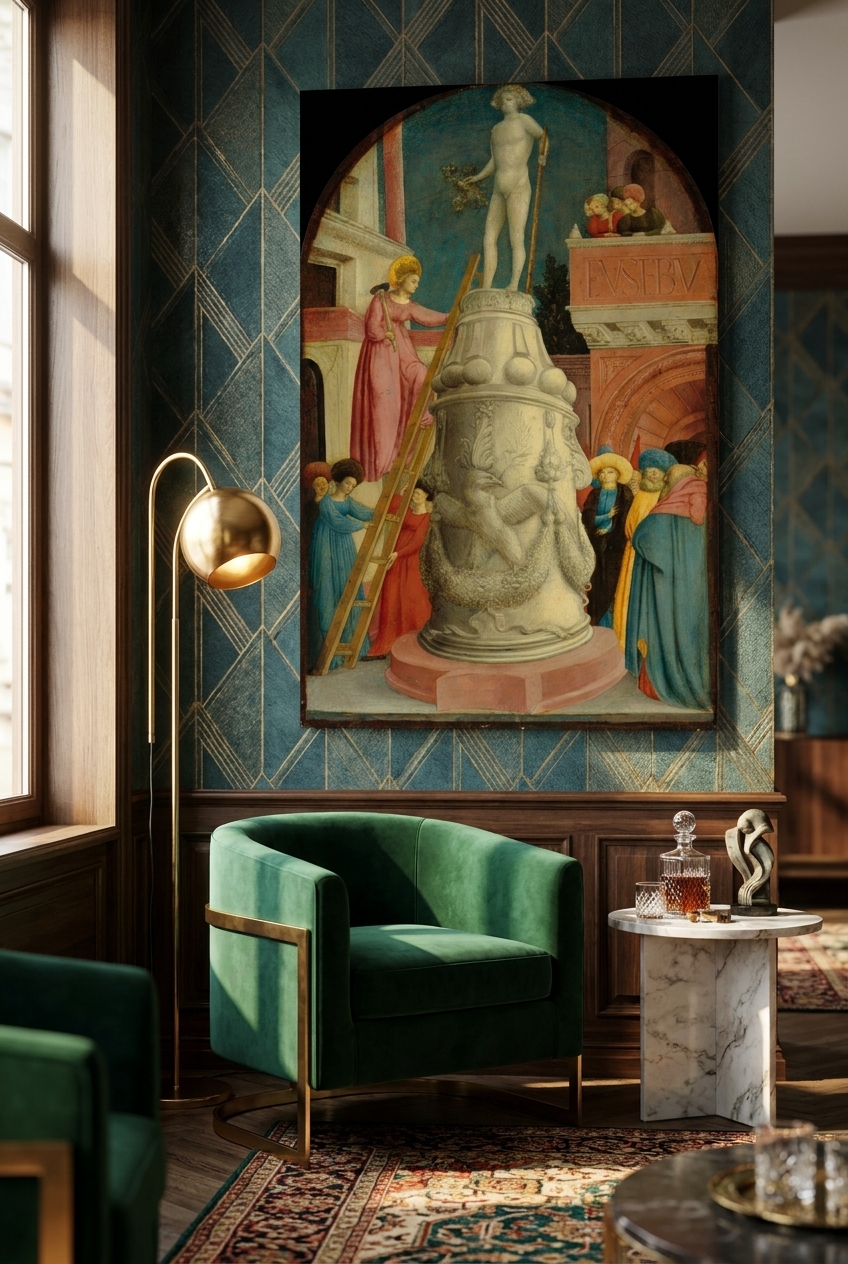
Tapestry, Gold, and Quiet Grace
To look at a painting by Giovanni d'Alemagna is to step into a space that feels both sacred and deeply tactile. His style is defined by a rich, tapestry-like surface quality. Intricate, raised plasterwork and heavy gilding catch the light, mimicking the opulent fabrics worn by Venice's merchant elite. Yet beneath this decorative surface lies a remarkable sense of order. His figures are not flat Gothic cutouts; they possess a quiet, classical poise and a solemn dignity.
In works like Saint Apollonia Destroys a Pagan Idol, we see this synthesis beautifully expressed. The architectural structures provide a firm, logical stage for a narrative filled with dramatic tension and luminous color. The precise rendering of the columns and tiled floors shows a keen interest in the new science of perspective, yet the scene remains steeped in a poetic, dreamlike atmosphere.
A Partnership of Masters
Giovanni's career is inseparable from his partnership with Antonio Vivarini, his brother-in-law. Together, they ran one of the most successful workshops in Venice, producing massive, multi-paneled altarpieces that defined the visual language of the region's churches. While Vivarini often painted the softer, more lyrical figures, Giovanni is believed to have contributed the complex architectural frameworks and the meticulous, precise details that gave their joint works such presence.
Exploring the Full Giovanni d'Alemagna collection reveals how this collaboration shaped the future of Venetian art. Their workshop paved the way for the grand, atmospheric style that would later define Venetian painting. Today, his surviving panels stand as rare testaments to a transitional era, celebrated for their complex iconographies and quiet poise.
Bringing Venetian Splendor Home
Why do these fifteenth-century masterpieces resonate so strongly in modern spaces? The answer lies in their unique balance of texture and tranquility. A high-quality print or canvas of Giovanni's work brings an immediate sense of warmth and history to a room. The rich, jewel-toned color palettes—deep blues, glowing crimsons, and warm golds—serve as sophisticated focal points that anchor a room without overwhelming it.
Placed in a contemporary home, a reproduction of his work acts as a window into a world of exquisite craftsmanship. The intricate details and luminous colors offer a daily reminder of an era when art was a bridge between the earthly and the divine, making them perfect for spaces where you want to encourage quiet reflection and conversation.
Frequently asked questions
What does the name 'd'Alemagna' mean?
The name 'd'Alemagna' translates to 'of Germany' in Italian. This strongly suggests that Giovanni was of German origin or training, which explains the Northern European precision and love for intricate detail found in his Venetian paintings.
How did Giovanni d'Alemagna collaborate with Antonio Vivarini?
Giovanni and Antonio Vivarini operated a highly successful joint workshop in Venice during the 1440s. They co-signed many major altarpieces, combining Vivarini's lyrical Italian figure style with Giovanni's detailed, structured, and heavily ornamented architectural settings.
Why are his surviving paintings considered so rare?
Giovanni's active career in Venice was relatively short, ending with his death in 1450. Because many fifteenth-century altarpieces were later dismantled, lost, or damaged over the centuries, his remaining individual panels are highly prized historical treasures.