
The Golden Light of Siena: Discovering Lippo Memmi
In short: A master of the Sienese Gothic style, Lippo Memmi combined delicate lines, rich gold punchwork, and human tenderness to create some of the Trecento's most mesmerizing sacred art.
The Quiet Master of Sienese Gothic
In the fourteenth century, the Italian city of Siena was a crucible of artistic revolution. While neighboring Florence pioneered a heavy, monumental realism, Sienese painters took a different path. They chose lyricism, delicate lines, and an almost otherworldly elegance. At the heart of this golden age was Lippo Memmi, a master of the Trecento who elevated the Sienese Gothic style to its absolute peak.
Working closely with his famous brother-in-law, Simone Martini, Memmi created paintings that feel less like physical objects and more like windows into a serene, spiritual realm. Together, they refined a style characterized by aristocratic grace and deep, meditative quietness.
The Art of Gold and Grace
To look at a painting by Lippo Memmi is to be dazzled by detail. He was a virtuoso of "punchwork"—the painstaking technique of stamping intricate patterns directly into gold leaf using tiny metal tools. This created halos and borders that caught the flickering candlelight of medieval churches, making the holy figures seem to glow from within.
But Memmi's genius went beyond decorative surface effects. His figures possess a delicate, elongated grace. Their hands are slender, their faces thoughtful, and their robes cascade in rhythmic, musical folds. Unlike the distant, severe icons of earlier Byzantine art, Memmi's subjects—particularly his Madonnas—radiate a quiet, humanized tenderness. You can explore these breathtaking details in our complete Lippo Memmi collection.
A Closer Look: The Madonna and Child
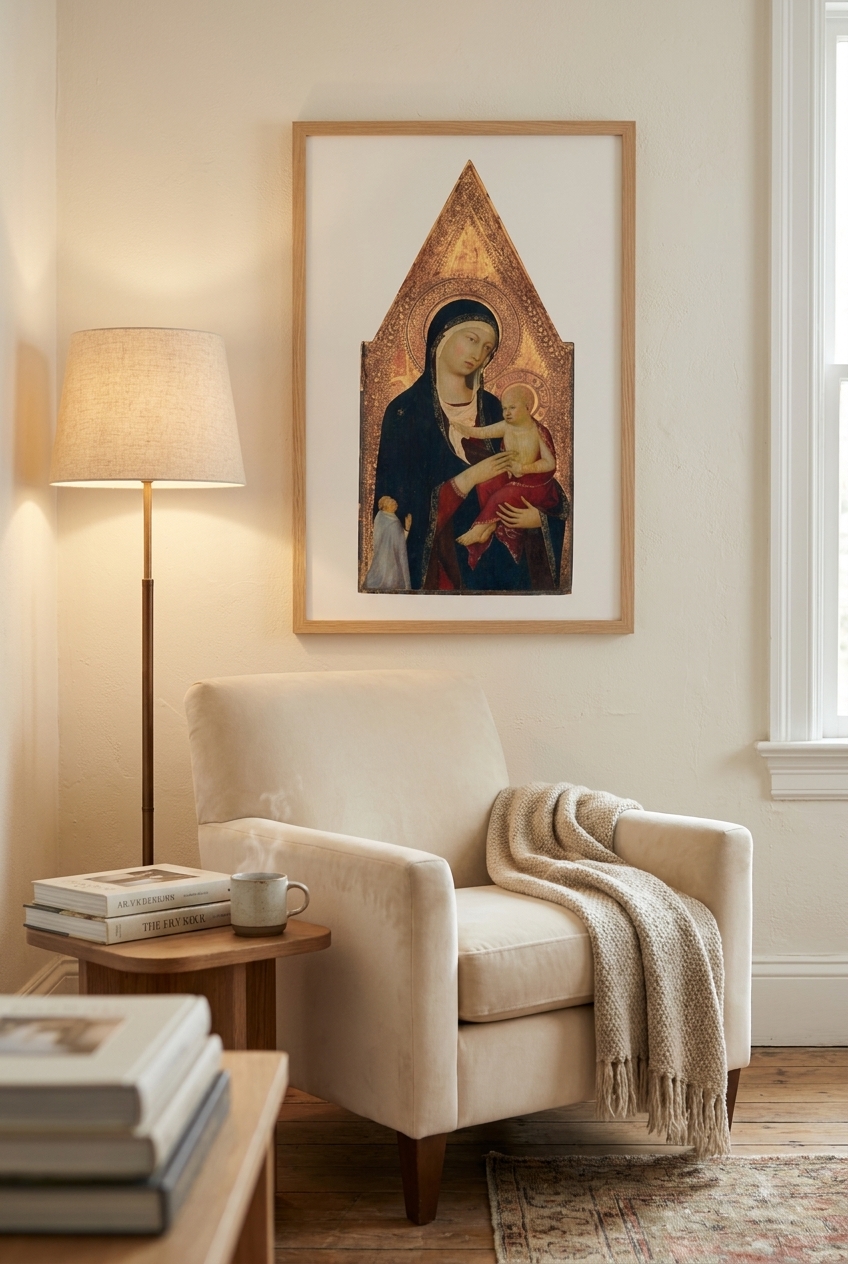
One of the finest examples of Memmi’s intimate style is his Madonna and Child with Donor, painted between 1325 and 1330. In this exquisite work, the Virgin Mary holds a remarkably lifelike Christ child, who gazes out with calm wisdom. Kneeling in the corner is the tiny figure of the donor, humbled in the presence of the sacred.
What makes this composition so striking is the balance between the flat, shimmering gold background and the soft, three-dimensional humanity of the figures. The jewel-like blues and rich reds of the drapery stand out vividly against the gilded backdrop, showcasing Memmi’s mastery of pigment and emotion.
Bringing the Trecento into the Modern Home
It might seem surprising that paintings created seven hundred years ago feel so at home in contemporary interiors. Yet, the qualities that define Memmi’s work—clean lines, rich textures, and a warm, golden color palette—are incredibly versatile.
In a minimalist modern room, a high-quality print of a Memmi masterpiece acts as a stunning focal point. The delicate gold tones add warmth to cool-toned walls, while the serene expressions of his subjects bring a sense of calm and history to busy living spaces. Whether printed on textured fine-art paper or stretched canvas, these works retain their luminous, meditative power, bridging the gap between medieval devotion and modern design.
Frequently asked questions
Who was Lippo Memmi?
Lippo Memmi (active c. 1317–1356) was an Italian painter from Siena, recognized as a leading master of the Sienese Gothic style during the Trecento period. He frequently collaborated with his brother-in-law, Simone Martini.
What is "punchwork" in Sienese painting?
Punchwork is a decorative technique where artists used small, patterned metal stamps to press intricate designs directly into the gold leaf background of a painting. This created textured, shimmering halos and borders that beautifully reflected candlelight.
How does Memmi's style differ from Florentine art of the same era?
While Florentine art (led by Giotto) focused on physical weight, volume, and dramatic realism, Sienese art under Memmi prioritized elegant linear patterns, elongated figures, rich decorative surfaces, and a lyrical, poetic atmosphere.
How do gold-leaf paintings translate to modern fine-art prints?
High-resolution modern printing captures the incredible tonal depth, fine punchwork details, and rich pigments of the original works. While printed gold doesn't physically reflect light like real gold leaf, the visual warmth and intricate textures are beautifully preserved on archival paper or canvas.