The Linear Grace of Agostino di Duccio: Sculpting the Wind
In short: Characterized by shallow reliefs and swirling, wind-blown drapery, the Style of Agostino di Duccio captures the poetic transition of the Early Renaissance, offering a serene, calligraphic beauty that translates beautifully into modern home decor.
The Poetry of Low Relief
In the heart of fifteenth-century Italy, a quiet revolution was taking place. While some Renaissance masters sought to conquer three-dimensional space with heavy, muscular realism, others pursued a path of pure poetic grace. The works created in the Style of Agostino di Duccio represent the pinnacle of this alternative vision. This manner of working is defined by its delicate, shallow reliefs—known as stiacciato—which beautifully bridge the boundary between sculpture and drawing.
Instead of carving deeply into the stone, artists working in this style barely grazed the surface. They coaxed figures out of the marble with lines so subtle they seemed drawn with a silverpoint brush rather than chiseled with steel. The result is an art of whisper-thin depth, where holy figures and classical myths exist in a luminous, dreamlike middle ground between our world and the next.
Wind, Waves, and Whispers
Works in this style are instantly recognizable by their ethereal, elongated figures and masterfully carved, swirling drapery that seems to flutter in an unseen breeze. There is a calligraphic quality to the contours, prioritizing rhythmic harmony and decorative elegance over strict anatomical realism. This artistic lineage celebrates the sublime beauty of form and movement, evoking a serene, neo-Attic classicism.
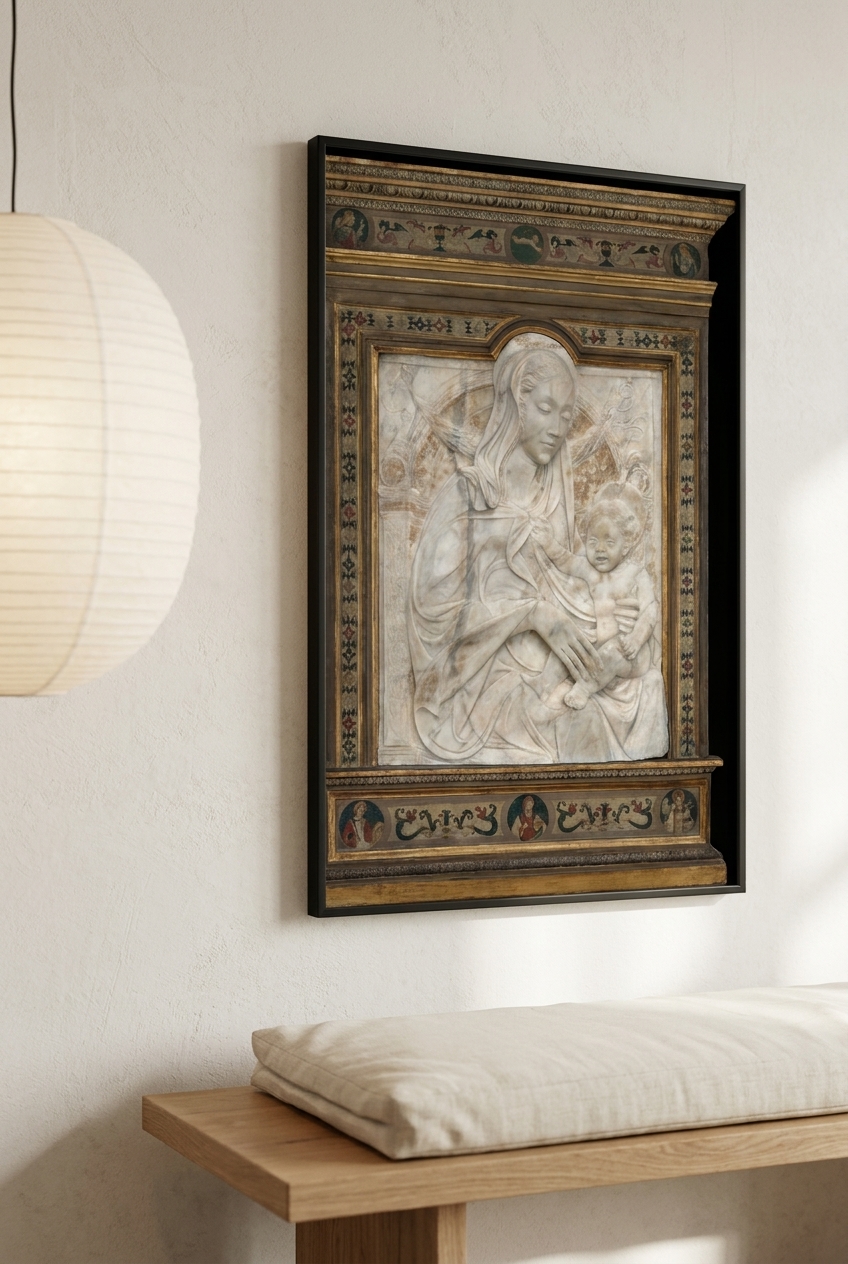
Consider the famous Madonna and Child from the 1460s. Here, the heavy garments of traditional medieval iconography are replaced by ripples of fabric that look like water flowing over river stones. The Virgin's veil loops and dances, framing her face with a gentle, rhythmic energy that guides the viewer's eye. It is not an attempt to mimic real wool or linen; instead, it is an expression of spiritual grace made visible through movement.
A Quiet, Luminous Gravity
Why do these fifteenth-century designs feel so remarkably modern today? The answer lies in their simplicity and restraint. Because these reliefs rely on subtle shifts in light and shadow rather than bold, saturated pigments, they possess a quiet, luminous gravity. They do not shout for attention; they invite quiet contemplation.
When reproduced as fine-art prints or canvases, the delicate lines of the Full Style of Agostino di Duccio collection bring a sense of architectural texture and calm elegance to contemporary spaces. The neutral, plaster-like tones and stone-carved textures blend seamlessly with minimalist, Scandinavian, or warm-industrial interiors. They offer the timeless weight of classical antiquity, but with a lightness of touch that keeps a room feeling airy and bright.
Frequently asked questions
What does "stiacciato" mean?
Stiacciato is an Italian term meaning "flattened" or "squashed." It refers to an extremely low-relief carving technique that allows an artist to create the illusion of depth using carving that is sometimes only millimeters deep.
How does a sculpture translate into a flat fine-art print?
Because the style relies so heavily on linear contours and the interplay of light and shadow, high-resolution photography captures the tactile, stone-carved quality of the original reliefs. On fine-art paper or canvas, the print retains the look of a three-dimensional plaster or marble carving.
What is "neo-Attic classicism"?
It is a style that looks back to the elegant, refined, and decorative qualities of ancient Greek art (particularly from the Attic region). It favors graceful curves, elongated proportions, and flowing drapery over the more robust, muscular realism of Roman art.