
The Luminous World of Matteo di Giovanni: Siena’s Master of Line and Light
In short: Matteo di Giovanni bridged the gap between medieval gold-leaf elegance and Renaissance realism, creating deeply emotional, visually striking Sienese masterpieces.
The Bridge Between Two Worlds
In the mid-fifteenth century, the Italian city of Siena was a place of artistic magic. While neighboring Florence pioneered the strict laws of perspective and anatomical realism, Sienese painters took a different path. They chose to preserve the lyrical, dreamlike beauty of the late Gothic style, prioritizing rich color, elegant patterns, and spiritual emotion. At the heart of this artistic golden age was Matteo di Giovanni, a master who brilliantly bridged these two worlds.
Active in Siena from the 1450s until his death in 1495, Matteo became one of the defining voices of the Sienese School. He did not reject the new humanist discoveries of the Early Renaissance; instead, he absorbed them. He learned to give his figures weight and spatial clarity, yet he wrapped them in the delicate, sweeping lines and shimmering gold leaf of traditional Sienese art. The result was a body of work that feels both earthly and divine, offering a serene yet dramatic intensity that continues to captivate viewers today. You can explore his breathtaking style in our Full Matteo di Giovanni collection.
The Anatomy of a Masterpiece
To look at a painting by Matteo di Giovanni is to enter a world of exquisite linear precision. His brushwork is incredibly fine, defining the gentle curve of a cheek, the intricate folds of a heavy silk robe, or the delicate fingers of a Madonna with absolute confidence. He worked primarily in tempera on wood panels, a medium that required meticulous patience and allowed for brilliant, jewel-like colors that do not fade with time.
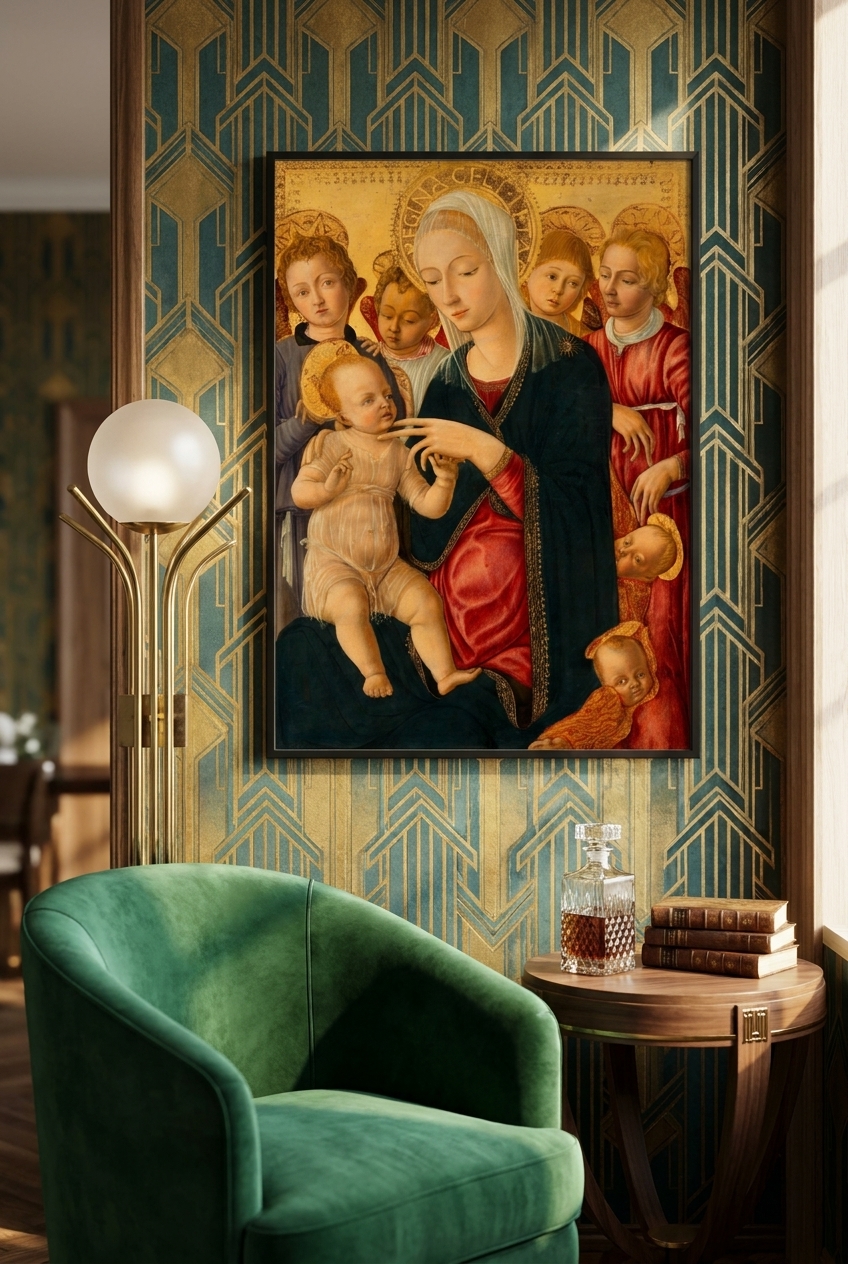
What truly sets Matteo apart, however, is his profound emotional sensitivity. His subjects are never static symbols; they breathe, feel, and interact. In his celebrated Madonna and Child with Angels and Cherubim, we see this emotional depth on full display. The Virgin’s expression is a quiet mix of maternal tenderness and solemn foresight, while the surrounding angels press close, their faces filled with individual personality and gentle wonder. Through his masterful use of gold leaf, Matteo creates a luminous surface where these complex human emotions unfold against a heavenly, reflective backdrop.
Bringing the Sienese Renaissance Into the Modern Home
It is easy to assume that fifteenth-century religious art belongs solely in museums, but Matteo di Giovanni’s work possesses a unique aesthetic that translates beautifully into modern living spaces. His paintings are, at their core, masterclasses in composition, color harmony, and line. The warm, glowing gold tones and rich lapis lazuli blues he favored bring an instant sense of warmth and history to a room, acting as a focal point that draws the eye without overwhelming the space.
In a minimalist or contemporary home, a high-quality archival print of Matteo’s work provides a striking contrast. The clean lines of modern furniture pair wonderfully with the intricate, hand-crafted details of the Renaissance. Whether framed as a commanding canvas or a classic paper print, his art introduces a sense of quiet contemplation, craftsmanship, and timeless elegance to our fast-paced modern lives.
Frequently asked questions
Who was Matteo di Giovanni?
Matteo di Giovanni (c. 1430–1495) was a premier Italian Renaissance painter of the Sienese School, celebrated for blending the decorative, gold-leaf style of the late Gothic period with the emerging realism and spatial clarity of the Early Renaissance.
What is the Sienese School of art?
The Sienese School refers to the artistic style that flourished in Siena, Italy, between the 13th and 15th centuries. Unlike the highly scientific and perspective-driven Florentine style, Sienese art focused on decorative patterns, vibrant colors, emotional expression, and a dreamlike, mystical quality.
How do these Renaissance prints look in modern interiors?
Beautifully. The warm gold tones, rich jewel colors, and elegant linework of Matteo's paintings provide a sophisticated contrast to modern, minimalist, or eclectic decor, adding texture, history, and a peaceful focal point to any room.