
The Quiet Grandeur of Attributed to Joseph Paul
In short: Mysteriously beautiful and deeply peaceful, the classical landscapes attributed to Joseph Paul offer a masterclass in light, shadow, and pastoral serenity.
The Mystery of the Master's Hand
There is a unique romance in the phrase "attributed to." In the world of fine art, it signals a detective story written in brushstrokes. It tells us that while a painting lacks a definitive signature, its soul, style, and execution point directly to a specific master. The works in the Attributed to Joseph Paul collection carry this captivating mystique. They invite us to look closer, not just at the mystery of authorship, but at the sheer beauty of the classical landscape tradition.
Joseph Paul’s name is tied to a style of painting that values order, harmony, and the quiet grandeur of the natural world. These are not hasty sketches of real-world locations, but carefully composed, poetic meditations on nature. By studying these pieces, we get a glimpse into an era when art sought to elevate the wilderness into something sublime and balanced.
The Classical Ideal of Nature
To understand these paintings, one must understand the classical European landscape tradition. During the eighteenth and nineteenth centuries, artists did not simply paint what they saw. Instead, they acted as directors, arranging trees, hills, and rivers to create a perfect, idealized scene. It was an art of balance.
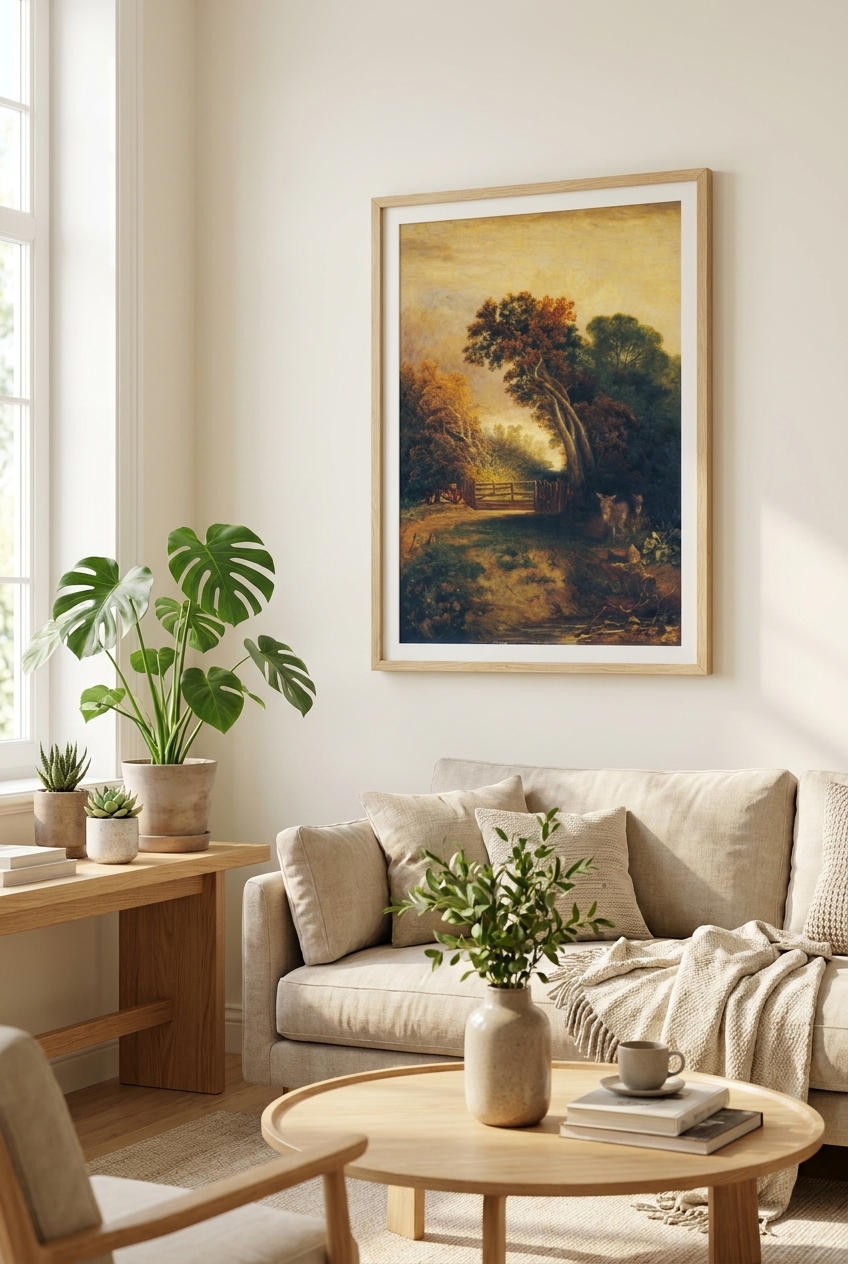
In these compositions, you will often find a framing device—perhaps a dark cluster of ancient trees on one side—that coaxes your eye gently toward a glowing horizon. The sky is never just a background; it is a source of soft, diffused light that bathes the entire countryside in a warm, golden haze. This deliberate arrangement creates a sense of profound order and peace, offering a refuge from the chaotic realities of everyday life.
Light, Shadow, and the Sublime
The visual signature of these works lies in their extraordinary handling of light and shadow. The artist uses a rich, earthy palette of deep forest greens, warm ochres, and soft, dusty blues. The brushwork is remarkably soft and blended, particularly in the rendering of foliage and clouds, which gives the paintings an atmospheric, almost dreamlike quality.
A perfect example of this technique is Landscape with Picnickers and Donkeys by a Gate. Here, the quiet drama of daily country life unfolds in a landscape that feels both intimate and vast. The play of light filtering through the trees onto the figures below exemplifies the artist's ability to turn a simple pastoral scene into a timeless moment of quietude.
Bringing the Pastoral Home
In a modern home, where clean lines and neutral palettes often dominate, a classical landscape print acts as a warm, grounding anchor. The deep, organic tones of these works bring a sense of history and warmth to a room without clashing with contemporary furniture. They function almost like extra windows, offering a view into a serene, idealized wilderness where time stands still.
Whether printed on textured canvas to highlight the soft, blended brushwork, or framed elegantly behind glass, these pieces bring a quiet, intellectual sophistication to any space. They invite guests to pause, breathe, and step, if only for a moment, into a world of timeless tranquility.
Frequently asked questions
What does "Attributed to" mean in art history?
An attribution means that while there is no definitive signature or documentation proving the artist's identity, art historians and experts believe, based on style, technique, and period, that the work was created by that specific artist.
What defines the style of these landscape paintings?
These works are characterized by their classical composition, featuring a harmonious balance of elements, a rich and earthy color palette, soft blended brushwork, and a dramatic but gentle play of light and shadow that evokes a sense of timeless tranquility.
How do these classical prints fit into modern home decor?
Their warm, organic tones and serene subject matter act as a visual anchor in modern spaces. They pair beautifully with minimalist, traditional, or transitional interiors, adding a layer of history, depth, and calm.