The Quiet Majesty of Bartolomeo Montagna
In short: Bartolomeo Montagna bridged the intellectual rigor of Padua with the luminous warmth of Venice, creating deeply serene, architectural masterpieces that bring a sense of permanent calm to any space.
The Master of the Venetian Mainland
While the glittering canals of Venice often dominate our view of the Italian Renaissance, some of the era's most compelling art flourished slightly inland. On the Venetian terraferma—the mainland provinces—artists forged a style that was uniquely grounded, intellectual, and powerful. At the absolute center of this regional movement was Bartolomeo Montagna, a master painter who made the city of Vicenza his creative fortress.
Montagna was not interested in fleeting whimsies or delicate, airy decorations. Instead, he absorbed the monumental, stone-carved strength of Andrea Mantegna and combined it with the radiant, golden clarity of Giovanni Bellini. The result was a singular aesthetic: a world of quiet permanence, where sacred figures stand with the dignity of ancient marble statues under a soft, atmospheric sky.
Stone, Light, and Silent Drama
To look at a painting by Montagna is to experience a profound sense of balance. His compositions are anchored by a rigorous spatial organization. He built his scenes like an architect, using sharp, defined contours and a deliberate, restrained color palette to give every figure a physical weight and a stoic, dignified presence.
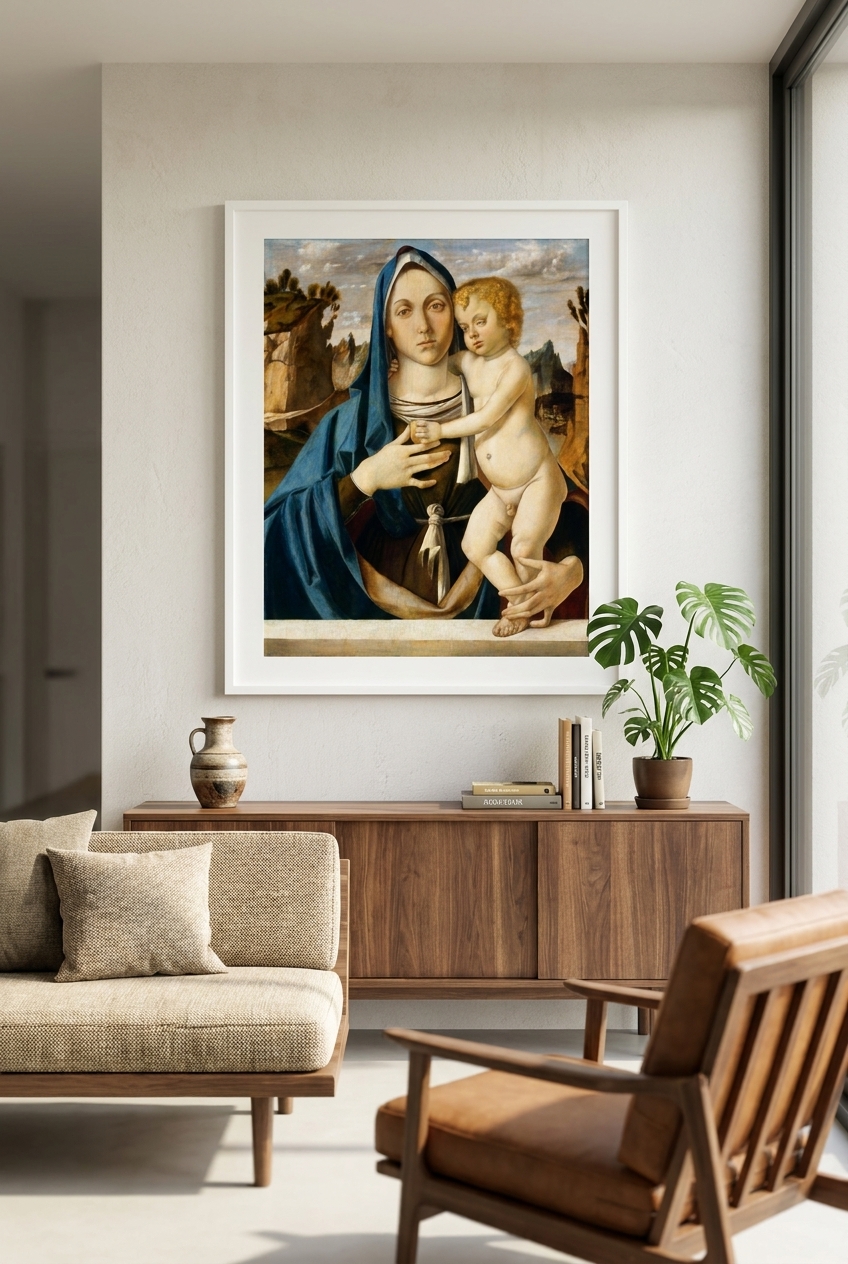
Yet, for all their sculptural gravity, Montagna’s works are never cold. He possessed a brilliant mastery of light. In his famous Madonna and Child (c. 1490), we see this balance beautifully realized. The figures are rendered with sharp drafting, but they are bathed in a gentle, warm glow that softens their edges and fills the space with quiet emotion. This interplay of hard form and soft light became his absolute signature.
Bringing Renaissance Serenity Home
In a modern home, Montagna’s work offers something rare: a sense of absolute stillness. In our fast-paced, highly saturated world, his structured compositions act as visual anchors. A high-quality canvas or framed print of his work doesn't shout for attention; instead, it stabilizes a room, bringing an air of classical elegance and intellectual depth to your walls.
Whether displayed in a minimalist living room or a classic study, these pieces harmonize beautifully with natural materials like wood, stone, and linen. To explore his full range of architectural beauty and serene light, we invite you to browse our Full Bartolomeo Montagna collection and find the perfect piece of the Italian mainland for your space.
Frequently asked questions
What makes Bartolomeo Montagna's style unique?
Montagna's style is defined by a unique blend of sculptural gravity and atmospheric light. Influenced by Mantegna's sharp, stone-like figures and Bellini's soft Venetian light, Montagna created highly structured, calm, and architectural compositions.
Where did Bartolomeo Montagna primarily work?
While he was influenced by the major artistic hubs of Venice and Padua, Montagna worked primarily on the Venetian mainland, establishing himself as the leading painter in the city of Vicenza.
How do Montagna's prints fit into modern interior design?
Because of their clean architectural lines, balanced compositions, and restrained color palettes, Montagna's works act as excellent grounding elements in modern interiors, pairing wonderfully with minimalist decor, natural wood, and neutral tones.