
The Quiet Order of James Vail: Classical Serenity for the Modern Eye
In short: James Vail combined classical academic precision with soft, atmospheric light to create landscapes of profound stillness. His work offers a perfect visual anchor for contemporary homes.
The Appeal of Stillness
In a world that often feels fast and fragmented, the paintings of James Vail offer a welcome pause. Rooted in the rigorous traditions of the classical academy, Vail’s work represents a lifelong devotion to balance, proportion, and the sublime order of the natural world. While other artists of his era chased fleeting trends, Vail looked backward to look forward, drawing deep inspiration from the pastoral landscapes of the eighteenth and nineteenth centuries to create something entirely timeless.
To explore his work is to step into a space where chaos does not exist. You can see this enduring commitment to harmony across the Full James Vail collection, where each piece serves as an invitation to slow down and observe.
Structure and Atmosphere
At first glance, Vail’s landscapes feel incredibly soft, almost dreamlike. But look closer, and you will find a masterful command of composition. Underneath the gentle tonal gradations and misty horizons lies a rigorous, geometric precision. Vail constructed his scenes with an architect’s eye for structure, ensuring that every tree, hill, and path was perfectly placed to balance the next.
This quiet tension between structure and serenity is the hallmark of his style. By pairing a restrained palette with atmospheric light, he managed to evoke a profound sense of contemplation. The light in a Vail painting does not flash or glare; instead, it glows softly from within, casting a quiet spell over the entire canvas.
Finding the Classical in the Everyday
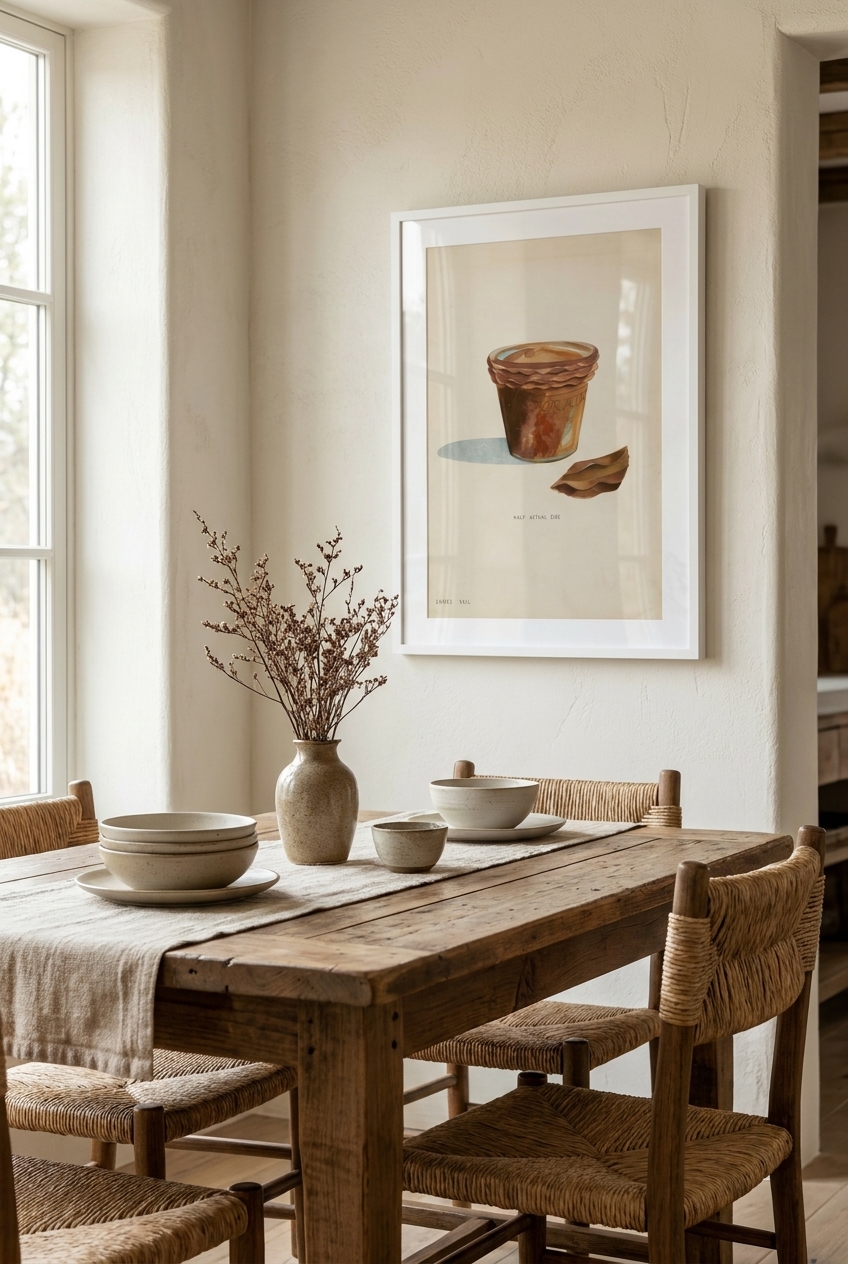
While Vail is best known for his sweeping, idealized vistas, his classical eye was equally adept at capturing smaller, intimate subjects. A perfect example of this is his still life work, such as "Flower Pot" (c. 1936). In this piece, the same principles of classical proportion and soft, atmospheric light are applied to a simple household object.
By treating a modest subject with the same reverence as a grand pastoral landscape, Vail reminds us that beauty and order are all around us, waiting to be noticed. It is this ability to elevate the ordinary that makes his work so enduringly popular among art lovers.
A Timeless Addition to the Modern Home
There is a unique joy in decorating with classical art. Because Vail’s work eschews bold, jarring colors in favor of earthy, muted tones, his pieces are incredibly versatile. They bring a sense of history and grounding to a contemporary room, acting as a quiet focal point rather than competing with your existing decor.
- Restrained Palettes: Soft greens, warm ochres, and gentle grays blend effortlessly with modern color schemes.
- Visual Balance: The geometric underpinnings of his work bring a sense of physical order and calm to living rooms, studies, and bedrooms alike.
- Museum Quality: When reproduced as fine-art prints or canvases, the delicate gradations of his atmospheric light are preserved beautifully, offering a gallery-like experience on your own walls.
Frequently asked questions
What defines James Vail's artistic style?
Vail’s style is defined by a classical devotion to balance, proportion, and geometric structure, all softened by atmospheric light and a restrained, gentle color palette.
How does Vail's work fit into modern interior design?
Because of his muted tones and quiet compositions, Vail's art acts as a calming visual anchor, blending seamlessly with both minimalist modern spaces and traditional decor.
What is the significance of the 'Flower Pot' painting?
It demonstrates how Vail applied classical principles of proportion and light to intimate, everyday subjects, proving that classical beauty can be found in the simplest of objects.