The Sculptural Silence of Alessandro Mastro-Valerio
In short: Alessandro Mastro-Valerio’s art captures the human form with sculptural grace, using soft light and poetic minimalism to create timeless, peaceful masterpieces.
The Quiet Power of Form
In a world that often feels loud and hurried, the artwork of Alessandro Mastro-Valerio offers a profound sense of stillness. An Italian-born artist who made his mark in the United States during the twentieth century, Mastro-Valerio became a master of Classical Realism. His work does not shout for attention; instead, it draws you in through an extraordinary display of balance, harmony, and quiet grace.
At the heart of his artistic philosophy was a deep reverence for the human form. Rather than treating his subjects as mere academic exercises, he infused them with a sculptural weight that feels both ancient and entirely contemporary. By exploring the Alessandro Mastro-Valerio collection, one immediately senses a bridge being built. He stood firmly in the grand tradition of classical draftsmanship, yet his clean lines and uncluttered compositions speak directly to the modern soul.
Light, Shadow, and Poetic Minimalism
What makes Mastro-Valerio’s style so distinctive is his masterly command of light and shadow. He relied on a meticulous rendering of tone, using soft, gradual transitions rather than harsh contrasts. This technique allows light to gently wrap around his figures, revealing the delicate contours of the body as if they were carved from marble. There is a tactile, three-dimensional quality to his prints that makes them feel incredibly alive.
But perhaps his greatest strength was his restraint. Mastro-Valerio had a rare ability to strip away extraneous detail. He did not clutter his backgrounds with unnecessary narrative or complex props. Instead, he embraced a poetic minimalism. In works like Motif In A Seascape-Three Nudes (c. 1949), we see how he places his figures within simplified, elemental landscapes. The sea, the sky, and the sand become abstract planes, leaving the viewer to focus entirely on the rhythm and relationship of the forms.
Why His Work Belongs in the Modern Home
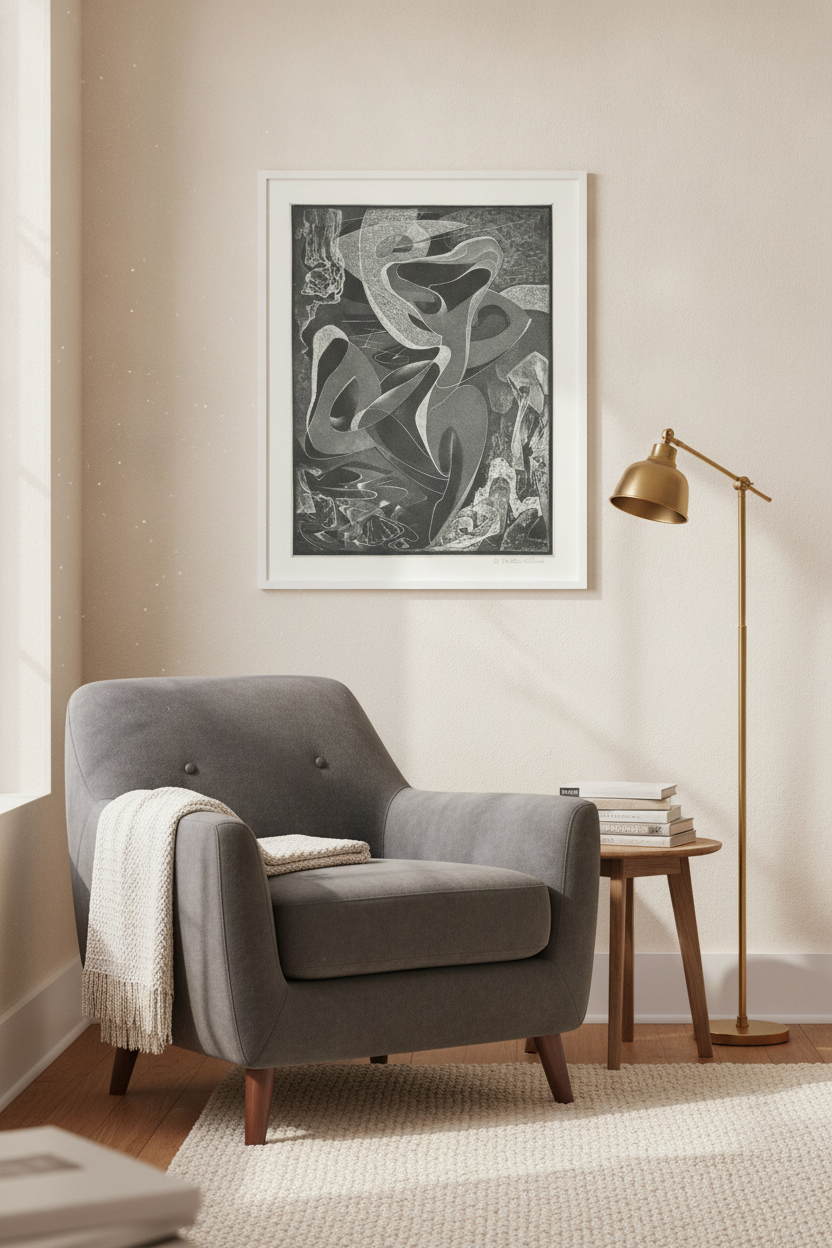
For those looking to curate a home that feels like a sanctuary, Mastro-Valerio’s work is a natural choice. His prints and canvases carry a monumental stillness that can anchor a room, bringing an immediate sense of calm and sophistication to any space. Because his color palettes tend toward soft, earthy tones and subtle monochromes, his pieces blend seamlessly into a variety of interior styles.
Here are a few reasons why his artwork translates so beautifully into modern living spaces:
- Versatile Elegance: His minimalist approach to figurative art complements both sleek, contemporary interiors and warm, traditional decors.
- Visual Rest: In a high-traffic area like a living room or entryway, his quiet compositions provide a moment of visual rest and contemplation.
- Museum-Quality Depth: The soft gradations of his tonal work are beautifully preserved on archival fine-art paper or textured canvas, highlighting the sculptural quality of his draftsmanship.
Whether displayed as a large, singular focal point or as part of a carefully curated gallery wall, Mastro-Valerio’s art reminds us of the enduring power of classic beauty. It is art that does not age, offering a timeless meditation on form and light that you will appreciate more with each passing year.
Frequently asked questions
What is Classical Realism, and how does Mastro-Valerio fit into it?
Classical Realism is an artistic movement that values the traditional skills of draftsmanship, perspective, and figurative representation handed down from the Renaissance and academic traditions. Mastro-Valerio fits into this by using rigorous anatomical drawing and classical composition, while simplifying his backgrounds to align with twentieth-century modernism.
What mediums did Alessandro Mastro-Valerio primarily work in?
He was highly skilled in various printmaking techniques, particularly mezzotint and etching, as well as painting. His mastery of these mediums allowed him to achieve the rich, velvety darks and incredibly soft tonal gradations that define his signature style.
How should I frame a Mastro-Valerio print for a contemporary space?
Because his work has a clean, minimalist quality, a simple, low-profile frame works beautifully. A thin black, dark wood, or natural oak frame with a generous white or off-white mat will highlight the delicate tones of the print without distracting from its quiet beauty.