
The Serene Order of Richard Barnett: Classical Harmony for the Modern Home
In short: Richard Barnett’s artwork combines classical balance with soft, atmospheric light. His meticulous, earthy compositions offer a soothing, grounding presence perfect for today's minimalist and organic modern interiors.
The Pursuit of Quiet Permanence
In a world that often feels hurried and fragmented, the art of Richard Barnett offers a rare sanctuary of order and quietude. Working within the disciplined lineage of the Classical tradition, Barnett dedicated his creative life to the pursuit of balance, proportion, and a sublime harmony. His compositions do not shout for attention; instead, they invite us into a space where nature and objects are governed by intellectual clarity and poetic restraint.
Classical art has always been less about capturing raw, unedited reality and more about finding the eternal within the temporary. Barnett understood this deeply. Drawing inspiration from the idealized landscapes of antiquity and the structured beauty of historical design, his work evokes a sense of quiet permanence. He looked at the world and saw an underlying geometry of peace, filtering out the chaotic noise of everyday life to leave behind only what is essential, balanced, and beautiful.
Light, Texture, and the Academic Touch
The true signature of Barnett’s style lies in his delicate orchestration of light and atmosphere. Rather than employing harsh, dramatic contrasts, he favored soft, diffused illumination and a muted, earthy palette. This choice allowed him to capture subtle, fleeting transitions of light with academic precision, prioritizing atmospheric depth over mere literal documentation.
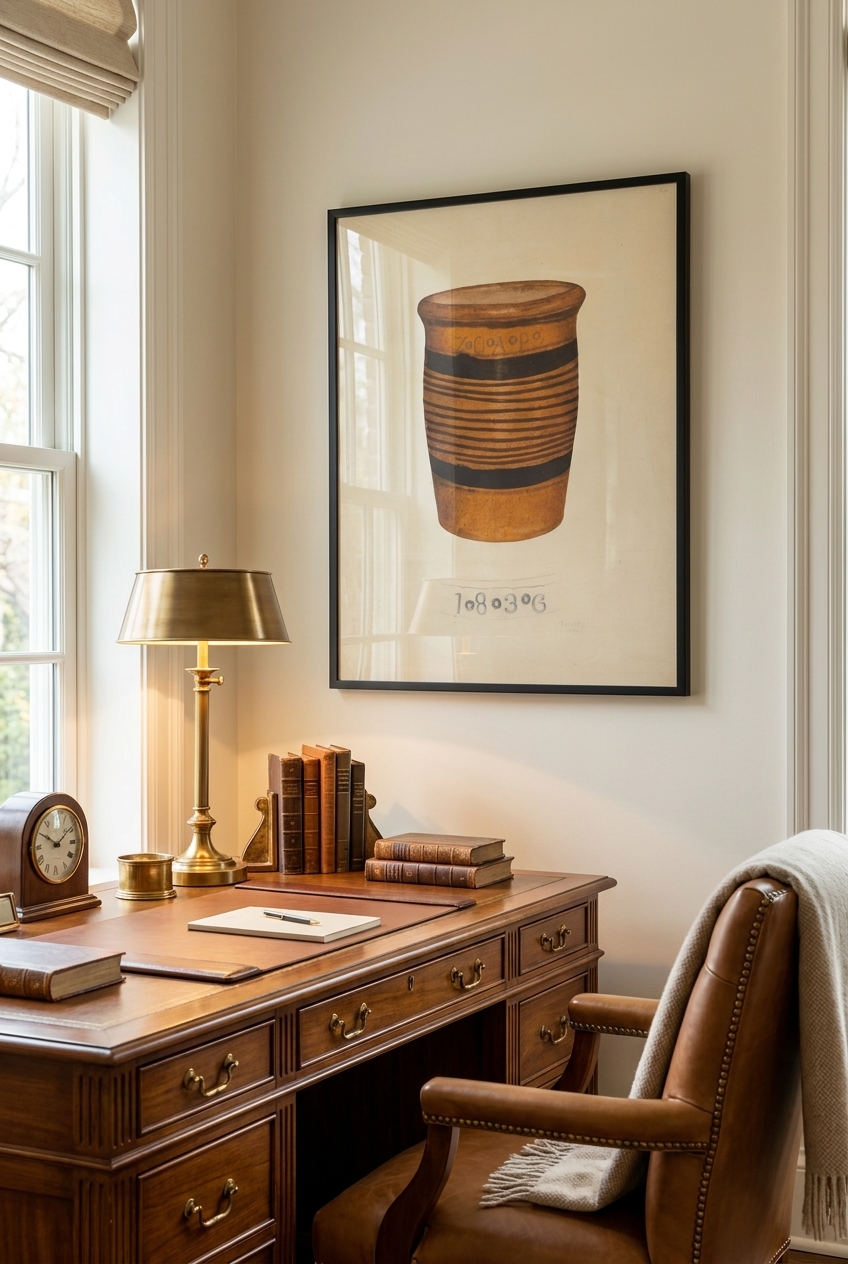
This masterclass in restraint is beautifully displayed in his celebrated Zoar Flower Pot (c. 1937). Here, a simple piece of regional earthenware and its delicate botanical occupant are rendered with the care of a classical monument. The gentle contours, the soft play of light on the clay, and the earthy, grounded tones show how Barnett could transform a humble object into a profound study of form and stillness. It is this ability to find monumental beauty in the modest that sets his work apart.
A Serene Anchor for the Modern Home
Why does an artist rooted in classical discipline resonate so strongly today? The answer lies in our modern craving for calm. Modern interiors—characterized by clean lines, natural light, and open spaces—benefit immensely from artwork that provides a grounding, peaceful presence. Exploring the full Richard Barnett collection reveals a body of work that acts as a visual anchor for any room.
Barnett’s palette of soft ochres, terracottas, muted greens, and gentle grays fits seamlessly into contemporary color trends, particularly warm minimalism and organic modernism. Whether displayed as a large-format framed canvas over a mantelpiece or as a pair of intimate fine-art prints in a study, his work brings a sophisticated, academic touch to a home. It offers a bridge between the rich history of classical draftsmanship and the clean, uncluttered aesthetic of 21st-century living.
Frequently asked questions
What art movement or style does Richard Barnett’s work belong to?
Richard Barnett worked within the Classical tradition, characterized by an emphasis on balance, proportion, academic precision, and idealized harmony rather than raw realism.
What color palettes are most common in Barnett's art?
Barnett’s work is known for its muted, earthy palette. You will find soft ochres, warm terracottas, gentle greens, and subtle grays, all rendered under soft, diffused light.
How does his work fit into contemporary interior design?
His clean compositions and calming, organic tones make his prints ideal for warm minimalist, organic modern, or transitional spaces. They offer a grounding visual anchor without overwhelming a room.