The Silent Drama of Line and Shadow: Henry Wolf after Winslow Homer
In short: In the late nineteenth century, master printmaker Henry Wolf elevated wood engraving to an independent art form, translating the powerful realism of Winslow Homer into quiet, monochromatic masterpieces of light and shadow.
The Art of Graphic Translation
In the late nineteenth century, printmaking was far more than a method of mass reproduction; it was a high art of translation. At the absolute peak of this era, a master engraver named Henry Wolf took the raw, elemental energy of Winslow Homer's paintings and reimagined them on wood blocks. This was not mere copying. Wolf was an artist in his own right, bridging the rugged realism of Homer with a refined, classical precision.
By exploring the full Henry Wolf after Winslow Homer collection, we can see how two distinct creative minds met. Homer provided the dramatic, atmospheric vision of the American wilderness and coastline, while Wolf provided the meticulous, quiet discipline of the burin—the engraver's tool. Together, they created something entirely new: a graphic language that captured the very soul of the original paintings in shades of black, white, and silver.
The Master of Tone and Line
To look closely at a print by Henry Wolf is to wonder how a block of hard wood could ever yield such soft, fluid tones. Traditional wood engraving often relied on harsh, stark contrasts. Wolf, however, developed a legendary level of tonal control. His incised lines are incredibly thin and closely spaced, curving and swelling to mimic the sweep of a painter's brush.
Instead of simply outlining shapes, Wolf used his lines to capture the play of light and shadow. He translated the heavy, wet atmosphere of a coastal storm or the soft glow of twilight into a rich spectrum of grays. His lines do not feel rigid; they feel painterly, carrying a classical sensibility that softens the raw power of Homer's original compositions without losing any of their monumental weight.
Capturing Homer's Coastal Drama
Winslow Homer is famous for his obsession with the sea, the weather, and the quiet, often perilous relationship between humanity and nature. Wolf’s engravings capture these themes with breathtaking intimacy. By stripping away Homer's rich oil colors, Wolf forces us to look at the pure structure, light, and drama of the scene.
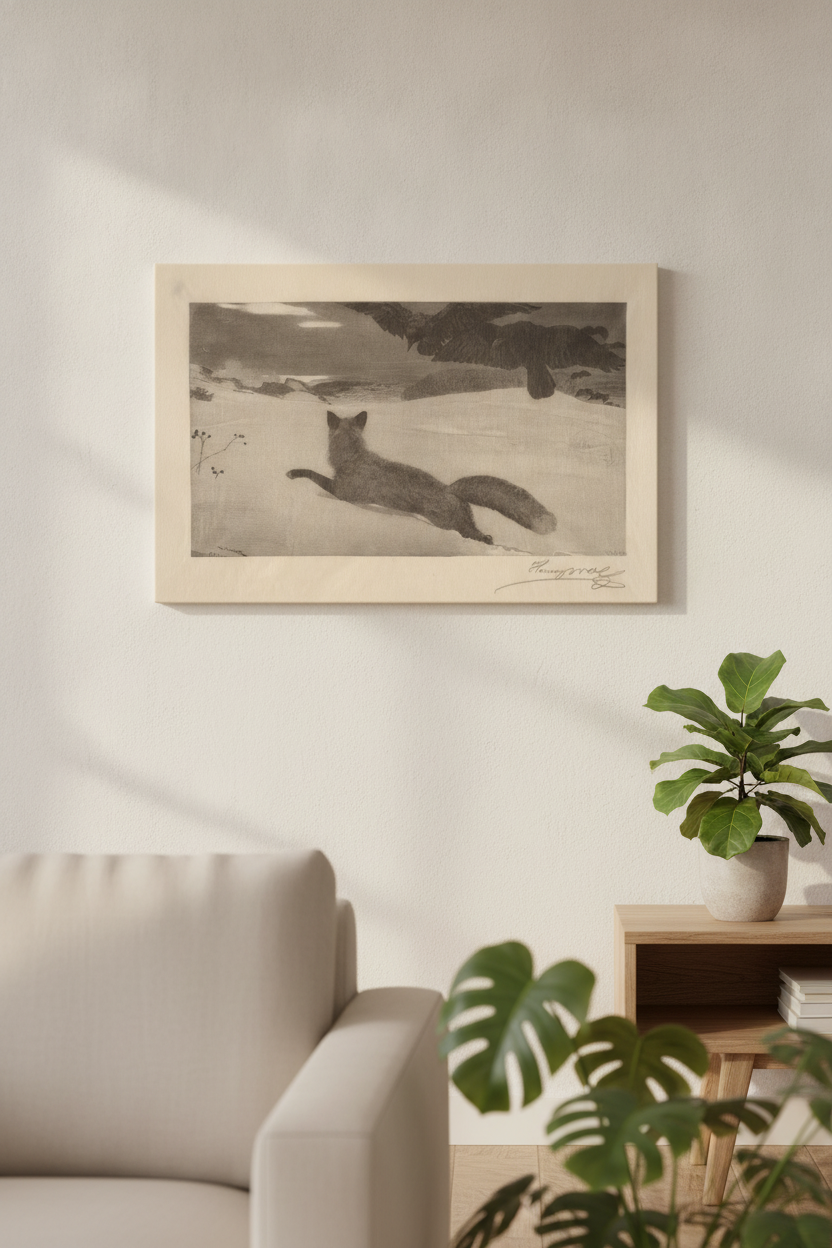
A prime example of this mastery is Winter, the Fox Hunt (1893). In this iconic image, the desperate struggle of a fox sinking into deep snow while crows hover menacingly overhead is rendered with incredible graphic tension. The stark white of the snow against the dark, textured feathers of the crows shows how Wolf could use a limited palette to evoke a profound sense of cold, silence, and survival.
Why These Prints Belong in the Modern Home
There is a quiet, contemplative beauty in monochromatic art that color paintings sometimes struggle to match. Because these wood engravings rely entirely on line and tone, they possess a timeless, architectural quality. They do not compete with a room’s color scheme; instead, they anchor a space with their rich textures and deep, velvety blacks.
In a modern home, a fine-art reproduction of a Wolf engraving offers an intellectual and visual focal point. Whether framed as a large-format canvas or a classic matted print, these pieces bring a sense of history, craftsmanship, and quiet drama to living rooms, studies, or hallways. They invite viewers to step closer, to marvel at the thousands of tiny lines that make up a single wave or a drifting cloud.
Frequently asked questions
What is an interpretive wood engraving?
Unlike mechanical reproductions, an interpretive wood engraving is a manual art form where an engraver translates a painting into a new medium. The engraver uses their own artistic judgment to recreate the tones, light, and textures of the original painting using only incised lines on a wooden block.
Who was Henry Wolf?
Henry Wolf (1852–1916) was an acclaimed French-born American wood engraver. He was widely regarded as one of the finest printmakers of his era, famous for his extraordinary ability to translate the works of great painters—like Winslow Homer and Whistler—into stunning, tonally rich graphic prints.
How do these monochromatic prints look in a contemporary interior?
Monochromatic wood engravings are incredibly versatile. Their black-and-white palette and rich graphic textures allow them to fit seamlessly into minimalist modern spaces, industrial lofts, or classic, traditional rooms without clashing with existing color schemes.