The Soft Light of Florence: Desiderio da Settignano and the Art of the Gentle Relief
In short: In 15th-century Florence, sculptors moved away from rigid medieval forms to capture tender human emotion. Through 'stiacciato'—a paper-thin relief technique pioneered by Donatello and perfected by Desiderio da Settignano—artists created breathtakingly lifelike portraits that still bring warmth and serenity to modern homes.
The Magic of the Florentine Bottega
In the middle of the fifteenth century, Florence was a city alive with dust, noise, and genius. Inside the local workshops, or bottegas, master artists and their apprentices worked side-by-side. They were not just making art; they were redefining how humanity saw itself. For centuries, medieval art had been stiff, formal, and distant. But in the Early Renaissance, Florentine sculptors began to look closely at real people—the way a child clings to a mother's skirt, the gentle curve of a neck, or the quiet sorrow in a young man's eyes.
This era was defined by a profound classical revival, but its true magic lay in its unprecedented naturalism and human emotion. Among the most celebrated figures of this golden age was Desiderio da Settignano. Though his life was short, his influence was immense. His workshop produced works of extraordinary sensitivity, characterized by soft contours and serene, idealized expressions that captured a poetic tenderness never seen before in stone.
The Whisper of Stone: Understanding Stiacciato
If you look closely at the works associated with Desiderio and his circle, you will notice something miraculous. The carvings are incredibly shallow, sometimes measuring only a few millimeters in depth. This technique is known as stiacciato, an Italian word meaning 'flattened' or 'squeezed.'
Pioneered by Donatello and perfected by Desiderio, stiacciato is more like drawing in marble than carving it. By using exceptionally low relief, the artist relies entirely on subtle gradations of light and shadow to create the illusion of deep space. A carved fold of drapery, a lock of hair, or a distant cloud is suggested by the faintest ripple in the surface. It is a technique of whispers rather than shouts, requiring an astonishingly delicate touch and an intimate understanding of how light behaves.
Grace Captured in Ink and Canvas
You might wonder how a three-dimensional marble or stucco relief translates into a two-dimensional fine-art print. The answer lies in the dramatic interplay of light and shadow that defined the original sculptures. When captured in high-resolution photography, the delicate ridges of the stiacciato technique are emphasized, creating a striking sense of depth and texture on paper or canvas.
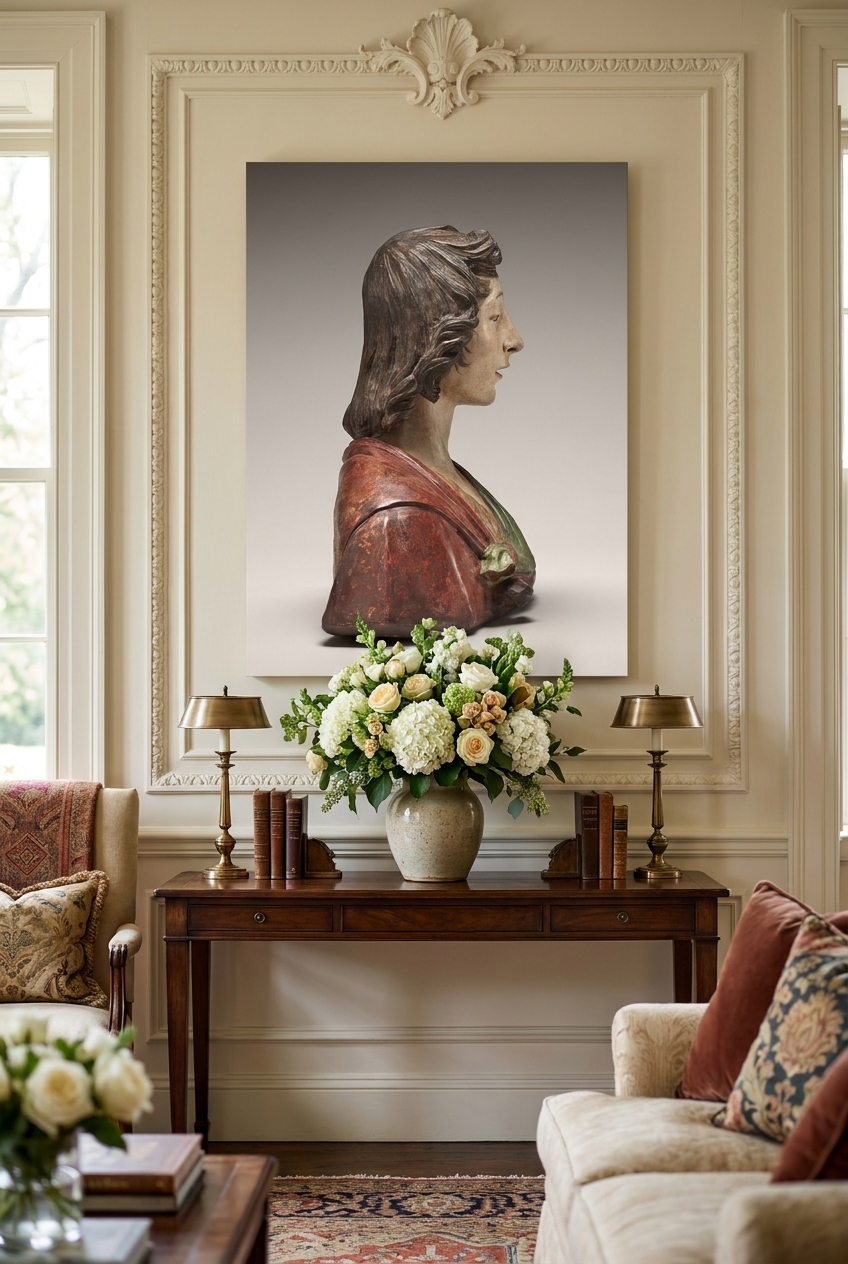
A perfect example of this is the hauntingly beautiful portrait of "Saint John the Baptist" (c. 1490). In this piece, the youthful saint is rendered with a quiet, introspective gaze. The soft rendering of his hair and the gentle, naturalistic folds of his garments show the lasting legacy of Desiderio’s workshop. On a modern wall, a print of this masterpiece retains all the tactile, sculptural presence of the original, transforming a flat surface into a window of classical grace.
Living with Renaissance Serenity
There is a timeless, calming quality to Early Renaissance art that makes it exceptionally well-suited for contemporary homes. Because these works rely on the natural colors of stone, terracotta, and plaster, they offer a sophisticated, neutral color palette. Warm creams, soft grays, and earthy ochres blend seamlessly into modern minimalist spaces, while adding a layer of historical depth that modern abstract art often lacks.
Whether you choose a framed print to hang in a quiet study or a large canvas to anchor a living room, these pieces bring a sense of peace and contemplation to your daily life. They remind us of a time when art was an intimate conversation between the human soul and the physical world. To explore these exquisite designs, we invite you to browse the Full Florentine 15th Century, probably after a model by Desiderio da Settignano collection and find a piece of the Florentine golden age for your own walls.
Frequently asked questions
What does 'probably after a model by Desiderio da Settignano' mean?
In the 15th-century Florentine workshop system, master sculptors like Desiderio da Settignano created highly prized original models in wax, clay, or plaster. Other skilled artists in his circle or workshop would then replicate or adapt these models in marble, stucco, or terracotta. This designation means the artwork reflects Desiderio's direct style and design, likely crafted by a talented contemporary follower.
What is the historical significance of stiacciato?
Stiacciato (flattened relief) was a revolutionary technique of the Early Renaissance. By carving extremely shallow reliefs—sometimes only a fraction of an inch deep—sculptors could apply the newly discovered rules of linear perspective to stone. This allowed them to create complex, atmospheric landscapes and lifelike figures with an unprecedented sense of depth.
How do these sculptural prints look on modern walls?
Remarkably striking. Because the original sculptures rely entirely on light and shadow to define their forms, high-quality fine-art prints capture these subtle contrasts beautifully. The neutral tones of the stone or stucco look elegant and sophisticated, offering a tactile, three-dimensional feel that complements both classic and modern minimalist interior designs.