What Makes Philip Johnson's Classical Studies So Timeless?
In short: Philip Johnson's classical studies and architectural renderings capture the timeless beauty of order and proportion, making them perfect prints for modern, minimalist homes.
The Quiet Power of Architectural Order
How does a simple architectural drawing capture our imagination so completely? The answer lies in the timeless pursuit of symmetry, balance, and ideal beauty that defines the classical tradition. In the architectural studies of Philip Johnson, we see this discipline brought to life with striking clarity. By removing any unnecessary clutter, each study highlights the core harmony and balance of the constructed world, turning complex spatial ideas into elegant visual poetry.
At first glance, an architectural rendering might seem purely functional. Yet, when we look closer, we find a profound artistic statement. These works do not merely document buildings; they capture the spirit of classical design, where structural clarity takes center stage. It is this balance of mathematical precision and artistic sensitivity that makes these pieces feel both historic and remarkably modern, answering our universal desire for structure and calm in a chaotic world.
From Antiquity to the Drafting Table
The classical style has never truly faded; instead, it has reinvented itself for every generation. From the Renaissance masters who measured Roman ruins by hand to the modern architects of the twentieth century, the allure of classical proportions remains unbroken. This tradition is built on the belief that certain geometric ratios resonate naturally with the human spirit.
When an artist or architect sits at a drafting table to render these forms, they are participating in a conversation that spans millennia. They are stripping away the temporary trends of their own era to focus on what is permanent: the strength of an arch, the grace of a column, and the perfect rhythm of a repeating motif. This dedication to enduring principles is why these drawings retain their power long after the ink has dried.
The Discipline of Line, Light, and Shadow
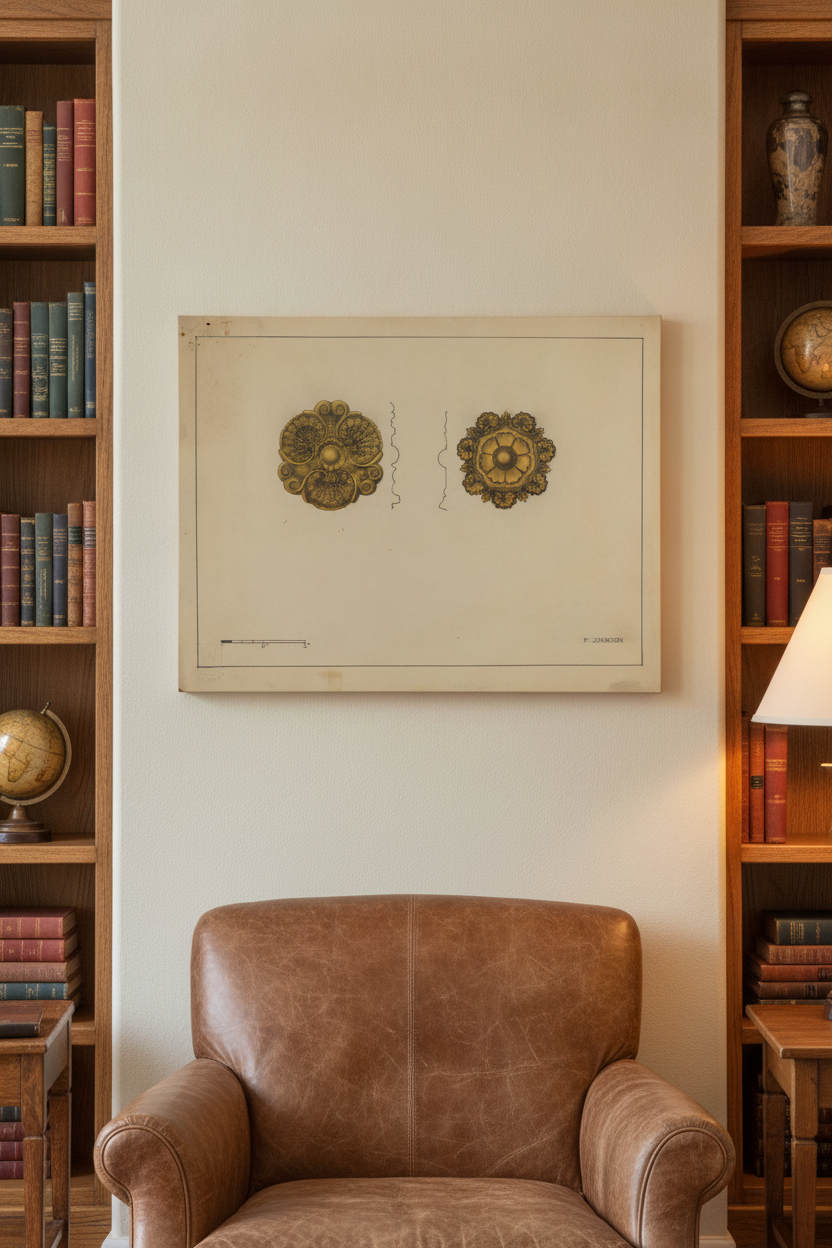
Taking cues from the grand ruins of the ancient world, these works celebrate clean lines and the strict application of mathematical proportions. In pieces like the exquisite "Rosette Mounts" (c. 1936), the drawing style shows immense respect for history, capturing the understated majesty of columns, arches, and detailed elevations with absolute precision.
But these drawings are far more than rigid technical exercises; they focus intensely on how light, shadow, and structural form interact. By focusing on how light washes over three-dimensional shapes, the artist creates a sense of depth and quiet drama. The soft gradients of grey and ink wash bring warmth to the cold stone structures, transforming a flat piece of paper into a window onto a three-dimensional world of perfect balance.
Why Architectural Art Belongs in the Modern Home
There is a unique sophistication in hanging architectural art on your walls. Unlike traditional landscapes or vibrant abstracts, architectural renderings offer a sense of structure, stability, and quiet intellect. They bring a grounding energy to a room, making them exceptionally well-suited for contemporary living spaces that value clean lines and thoughtful design.
Whether you choose a framed print or a textured canvas, these minimalist yet detailed studies bridge the gap between historic grandeur and modern minimalism. Exploring the Full Philip Johnson collection reveals how beautifully these clean lines and balanced compositions complement modern furniture, neutral color palettes, and open-plan interiors. They invite viewers to pause, appreciate the math behind the beauty, and find calm in perfect symmetry.
In a modern home, where we often seek to balance technology with natural materials and classic forms, an archival print of a classical study acts as a bridge across eras. It speaks of history, craft, and a timeless dedication to beauty that never goes out of style.
Frequently asked questions
What is the appeal of classical architectural art in a modern home?
Classical architectural art brings a sense of order, symmetry, and grounding calm to modern interiors. Its clean lines and balanced compositions complement minimalist decor while adding historical depth and intellectual sophistication.
What makes Philip Johnson's architectural drawings unique?
These drawings beautifully balance technical draftsmanship with artistic sensitivity. By focusing on the interplay of light, shadow, and geometric form, they transform precise structural studies into evocative works of visual poetry.
How should I frame these architectural prints?
To highlight their clean lines and classic proportions, we recommend simple, elegant frames in black, dark wood, or natural oak, paired with a generous white mat. This keeps the focus on the meticulous detail of the artwork itself.