Why are Perkins Harnly's interior paintings so mesmerizing?
In short: Perkins Harnly captured the soul of historic American interiors with the precision of a classical master and the dramatic flair of a portraitist.
Who was Perkins Harnly and why does his work matter?
At first glance, an empty room is just a collection of inanimate objects. But in the hands of Perkins Harnly, a Victorian parlor, a dusty attic, or a sunlit conservatory becomes as expressive and alive as any human subject. Active during the mid-20th century, Harnly was a master of Classical Realism who dedicated his brush to capturing the structured elegance of historic American interiors. Why are his paintings so mesmerizing? Because he did not merely document spaces; he gave them a distinct personality, elevating everyday decorative arts into the realm of high portraiture. Working extensively with the New Deal's Index of American Design, Harnly saved a vanishing world of 19th-century craftsmanship from obscurity. Today, exploring the full Perkins Harnly collection reveals an artist obsessed with the quiet drama of indoor spaces, turning architectural drafting into a deeply poetic art form that resonates across generations.
What defines his unique visual style?
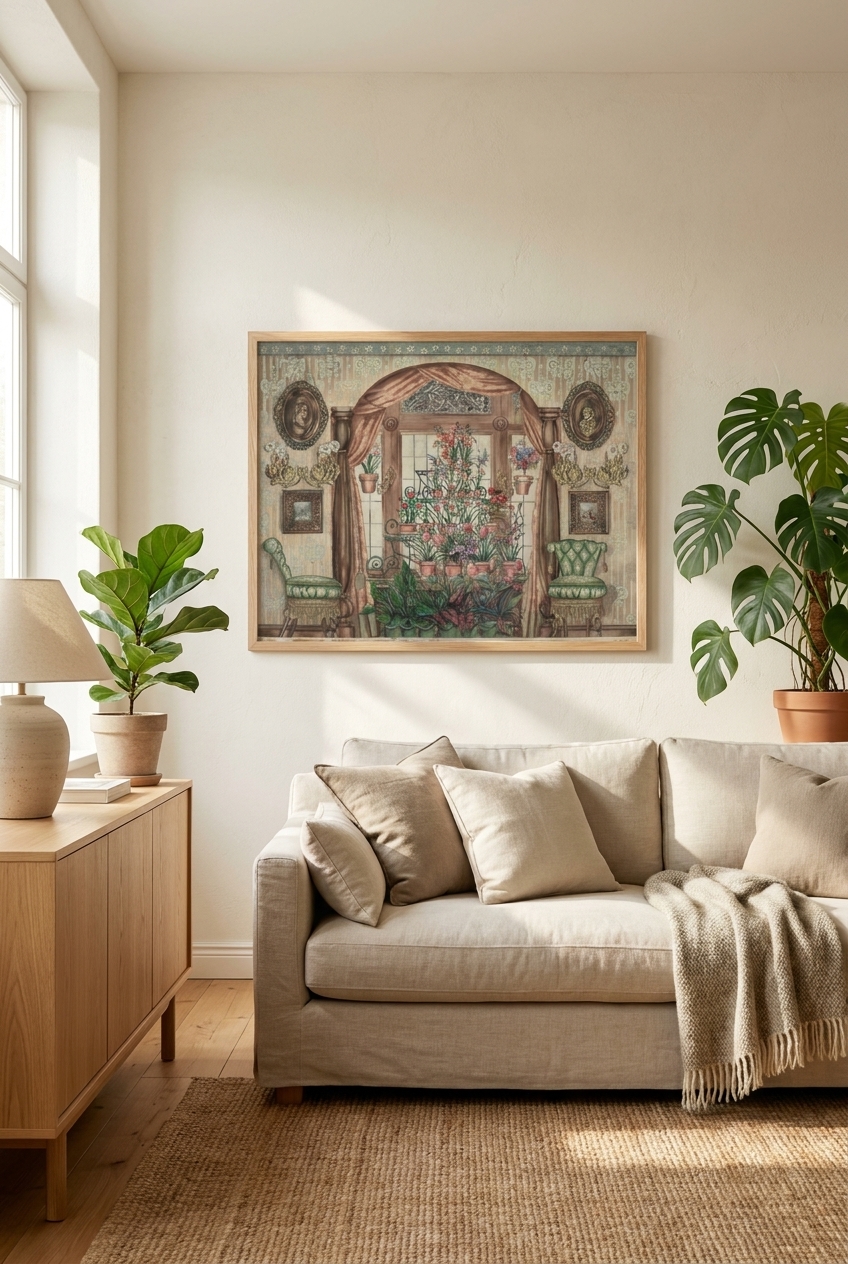
To truly appreciate Harnly's genius, one must look closely at his rigorous draftsmanship. His style is defined by an exacting precision and a deep reverence for classical order, symmetry, and balance. While many of his contemporaries turned toward abstract expressionism, Harnly remained steadfastly committed to the physical world, rendering complex architectural elements with breathtaking clarity. He had a rare gift for translating intricate ornamentation—carved wooden moldings, heavy velvet drapes, patterned wallpapers, and brass fixtures—into balanced, serene visual narratives. In masterpieces like Conservatory Window with Flowers, we see how he masterfully manipulated light and shadow to create depth. The light does not just illuminate the room; it tells a story of time passing, casting soft, long shadows that make the space feel lived-in, quiet, and deeply nostalgic.
The magic of bringing Harnly's world into a modern home
Harnly's paintings possess a unique quality: they are simultaneously highly detailed and remarkably peaceful. This exquisite balance makes his work exceptionally well-suited for modern living spaces. In a contemporary home, where clean lines and minimalism often dominate, a fine-art print of a Harnly interior acts as a warm, grounding anchor. His strict adherence to classical proportions means his compositions naturally bring a sense of spatial harmony to any room they inhabit. Whether printed on archival paper or stretched canvas, the rich textures and deep, jewel-toned palettes of his work invite viewers to step closer, to linger, and to explore the fine details. They are conversation starters that bridge the gap between historic grandeur and modern simplicity, proving that classical design is truly timeless.
Frequently asked questions
What art movement did Perkins Harnly belong to?
Perkins Harnly is closely associated with Classical Realism and the American Scene painting movement of the mid-20th century. He is best known for his meticulous watercolor renderings of historic American interiors for the Index of American Design.
How did Harnly capture such fine details in his paintings?
Harnly achieved his extraordinary detail through rigorous draftsmanship, careful study of perspective, and a highly disciplined watercolor technique. He treated decorative objects and architectural features with the same reverence and precision usually reserved for portrait painting.
Why are his works ideal for modern home decor?
His compositions are built on classical principles of symmetry and spatial harmony, which bring a sense of balance and calm to modern rooms. The rich textures and historical charm of his subjects add depth and character to contemporary interiors.