Why did Renaissance art start in Florence?
In short: The Early Florentine Renaissance transformed art by introducing perspective, human anatomy, and emotional realism. Discover how masters like Castagno and Pesellino shaped this golden age.
The Spark in the City-State
In the early years of the fifteenth century, the Italian city of Florence was a bustling, wealthy republic of merchants, bankers, and craftsmen. It was here, in this highly competitive and intellectually charged environment, that the Middle Ages quietly gave way to a cultural explosion. Florence became the cradle of the Early Renaissance because of a unique convergence of wealth, civic pride, and a radical new philosophy: humanism.
Instead of viewing humanity as inherently flawed and worldly life as a mere waiting room for the afterlife, Florentine thinkers began to celebrate human potential, reason, and the beauty of the natural world. Artists stopped looking solely to medieval templates and turned their eyes to the ruins of classical antiquity and the direct observation of nature. The city itself felt alive with creation, filled with the sound of stonecutters and the sight of scaffolding rising around the great cathedral dome.
The visual results were revolutionary. Painters and sculptors abandoned the flat, golden, two-dimensional spaces of Gothic art. Led by the mathematical discoveries of architect Filippo Brunelleschi, they embraced linear perspective—a system that allowed them to paint three-dimensional space on a flat surface for the very first time. Suddenly, paintings were no longer flat walls of symbols; they were windows into deep, breathable worlds.
The Masters of Realism and Grace
To truly understand this era, one must look at the artists who pushed these boundaries. Unlike the serene, idealized figures of the High Renaissance, the pioneers of the Early Florentine Renaissance painted with a raw, sculptural intensity and a deep commitment to human individuality.
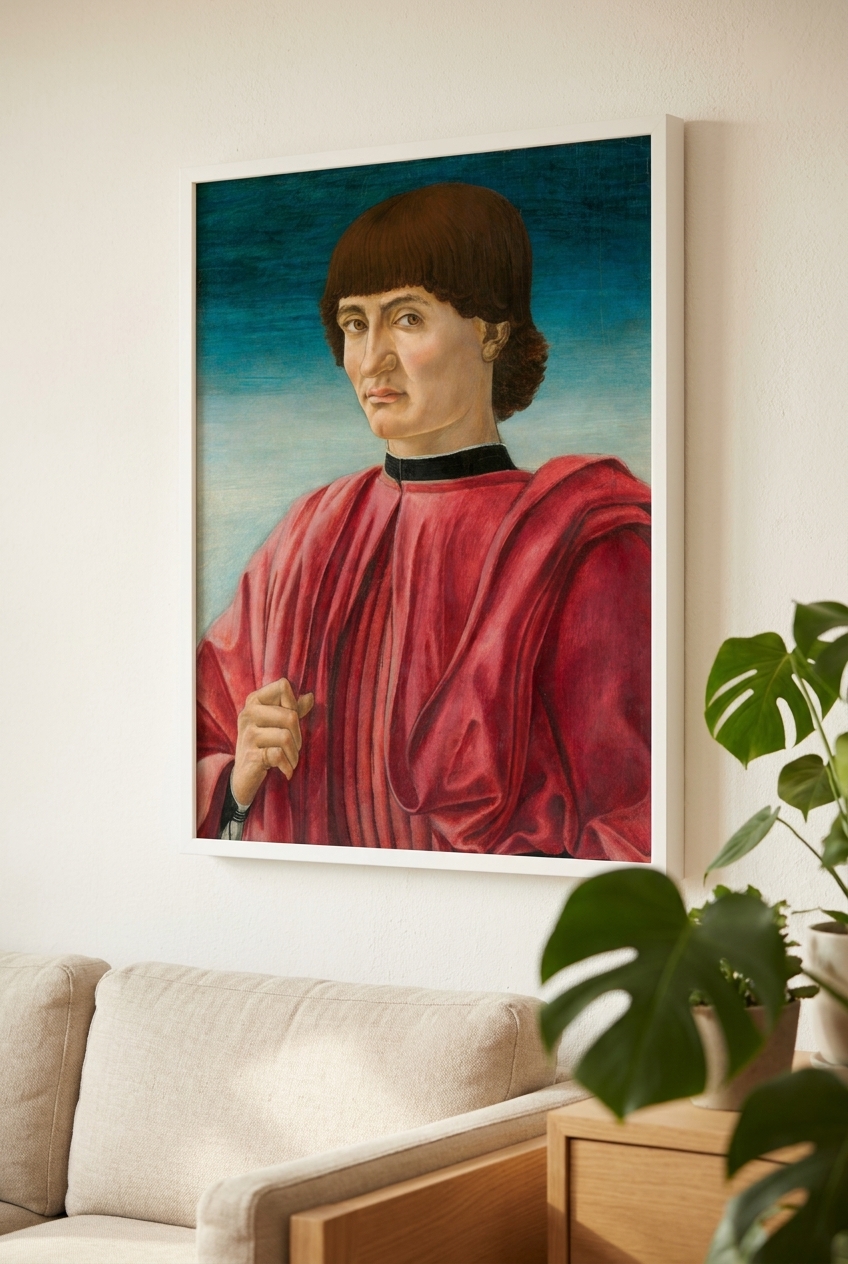
Take Andrea del Castagno, for example. Castagno was famous for his powerful, almost chiseled figures that seemed to leap off the plaster. His work possesses a muscular energy and a psychological depth that was entirely new to the period. In his Portrait of a Man (c. 1450), we see this approach in action. The subject is not a flat icon, but a living, breathing individual with a sharp gaze, defined bone structure, and a distinct, proud personality. This focus on the individual is the very essence of Renaissance humanism.
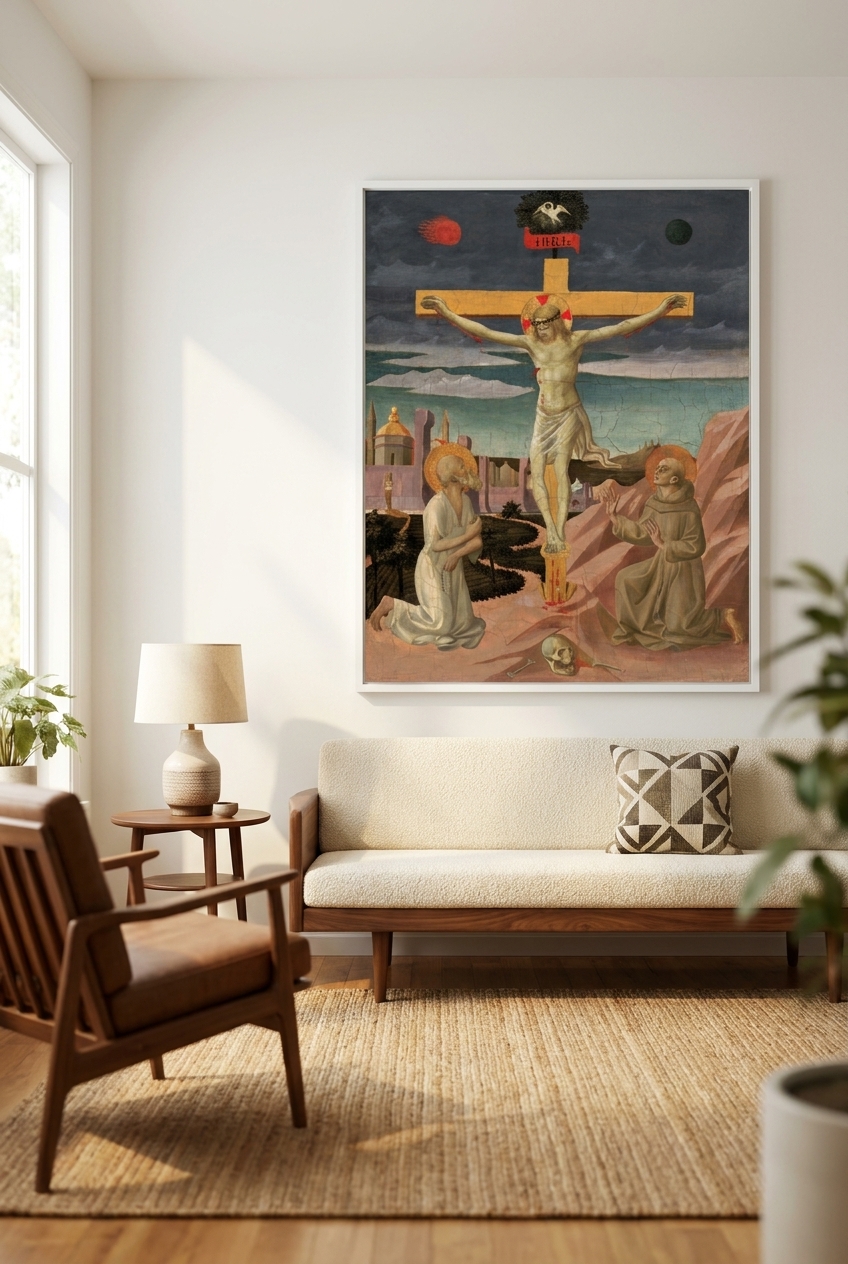
In contrast, but equally masterful, was Francesco di Stefano, known to history as Pesellino. Pesellino brought a delicate, poetic refinement to Florentine art, combining the new science of perspective with a rich, jewel-like color palette. His masterpiece, The Crucifixion with Saint Jerome and Saint Francis (c. 1445/1450), beautifully demonstrates this balance. The composition is quiet, symmetrical, and deeply moving, set against a vast, atmospheric landscape that invites the viewer to step inside and contemplate.
How to Read an Early Florentine Masterpiece
When you look at a painting from this era, you are looking at a visual puzzle solved by genius. To fully appreciate these works on your own walls, keep an eye out for three key elements:
- The Horizon Line: Look for the vanishing point. Early Renaissance artists loved to show off their mastery of perspective by aligning buildings, tiled floors, and even clouds toward a single, invisible point on the horizon, drawing your eyes deep into the canvas.
- Anatomical Weight: Notice how the figures stand. Unlike medieval figures that seem to float weightlessly, Early Florentine figures have gravity. They stand firmly on the ground, with muscles, drapery, and bones responding to real physical forces.
- Emotional Truth: Look closely at the faces. You will see grief, contemplation, pride, and quiet devotion. These were real people painted from life, bringing a profound sense of empathy to sacred and secular scenes alike.
Bringing the Renaissance into the Modern Home
You do not need a grand villa in Tuscany to appreciate the beauty of Early Florentine art. In fact, these works are uniquely suited to modern living spaces. Because this era was so deeply concerned with geometry, balance, and architectural order, the compositions have an inherently calming, grounding effect on a room.
A portrait with clean, graphic lines or a serene landscape with balanced figures provides a sophisticated focal point without overwhelming a space. When styling these prints, consider pairing them with natural materials like warm woods, linen, and brass to echo the organic, earthy pigments used by the original masters. Whether placed in a minimalist study or above a clean-lined living room sofa, an Early Florentine reproduction brings a sense of history, intellectual depth, and timeless beauty to your walls.
Frequently asked questions
What is the difference between the Early Renaissance and the High Renaissance?
The Early Renaissance (mostly 15th-century Florence) was a period of discovery, experimentation, and raw realism, where artists first mastered perspective and anatomy. The High Renaissance (early 16th-century Rome and Venice, led by Da Vinci and Michelangelo) took these discoveries and refined them into grand, idealized, and highly harmonious compositions.
What materials did Early Florentine artists use?
Most paintings from this era were either frescoes (painted directly onto wet plaster walls) or tempera on wood panels, which used egg yolk as a binder for natural pigments. Oil painting was just starting to be introduced from Northern Europe toward the end of the 15th century.
How do I choose a frame for an Early Renaissance print?
Because these works feature strong geometric compositions and rich, historic colors, they look exceptional in dark, slender wooden frames or classic gold gilt frames. This honors the architectural and historic nature of the art.