Why does Andrea del Castagno's realism feel so modern?
In short: Andrea del Castagno rejected Gothic elegance for a muscular, sculptural realism inspired by Donatello. His dramatic use of perspective and intense psychological depth make his masterpieces powerful focal points in modern interiors.
A Radical Departure from Gothic Elegance
In 15th-century Florence, while many painters still favored the delicate, gold-leafed elegance of the late Gothic style, Andrea del Castagno chose a radically different path. He painted people with dirt under their fingernails, muscles bunched with tension, and faces etched with real, human emotion. This uncompromising realism is why his work still feels so startlingly modern today.
Castagno did not want to paint distant, idealized saints. Instead, he wanted his figures to occupy actual, heavy space. By combining the classical proportions of antiquity with a raw, expressive energy, he created art that leaps off the wall. When you look at his work, you are not just looking at a flat image; you are looking at a physical presence.
The Sculptural Influence of Donatello
To understand Castagno’s style, you have to look at the sculptors of his time, particularly Donatello. Castagno was deeply inspired by how Donatello carved weight, gravity, and emotion into stone. He decided to do the same with paint.
His secret lay in extraordinary draftsmanship. Castagno used sharp, decisive outlines to carve his figures out of the background, giving them an almost architectural solidity. He then applied dramatic chiaroscuro—the contrast between deep shadow and bright light—to make muscles and drapery pop with tactile energy. Through a masterful use of foreshortening, he made limbs and bodies seem to project directly into the viewer's space, creating an intense physical tension.
Psychological Depth and Masterful Portraits
Beyond his technical mastery of perspective, Castagno was a pioneer of psychological realism. He had a rare ability to capture the internal life of his subjects, rendering them not as flat icons, but as complex individuals with intense inner worlds.
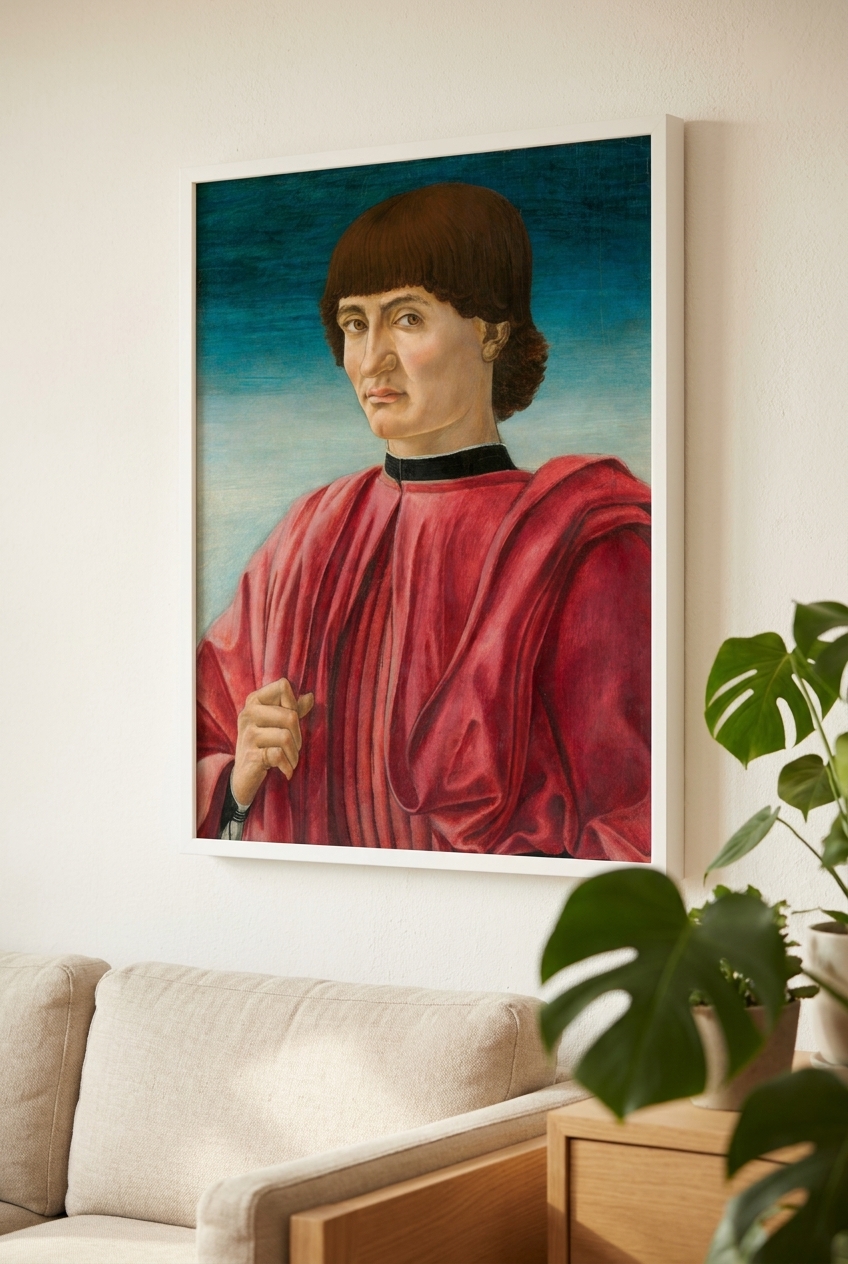
A perfect example of this is his famous Portrait of a Man (c. 1450). In this striking piece, the subject stares out with an arresting, confident gaze. The sharp modeling of the face and the bold contrast of the red garment against the dark background show Castagno at the height of his powers. It is an image that refuses to be ignored, capturing a fleeting human moment with permanent, monumental dignity.
Bringing Castagno's Drama into the Modern Home
Because Castagno’s work is so bold and structural, it translates beautifully into modern living spaces. His clean lines, dramatic lighting, and strong sense of geometry fit perfectly with contemporary interior design, offering a striking counterpoint to minimalist decor.
Whether displayed as a framed textured print or a large-format canvas, his masterworks bring a sense of history, intellectual rigor, and quiet strength to a room. You can explore these powerful, gravity-defying images in our full Andrea del Castagno collection to find a piece that adds a commanding, classical presence to your home.
Frequently asked questions
Who was Andrea del Castagno?
Andrea del Castagno (c. 1419–1457) was an influential painter of the Florentine Early Renaissance. He is best known for his muscular realism, mastery of perspective, and pioneering use of psychological depth in his portraits and frescoes.
What makes his painting style unique for the Renaissance?
Unlike his contemporaries who favored soft, idealized figures, Castagno painted with a sculptural, gravity-bound realism. Inspired by the sculptor Donatello, he used sharp outlines, heavy shadows (chiaroscuro), and dramatic foreshortening to make his figures appear three-dimensional and intensely physical.
How do Castagno's works look as modern art prints?
Exceptionally well. His strong geometric compositions, high-contrast lighting, and clean, sculptural lines make his works powerful focal points in modern interiors, especially when printed on high-quality archival canvas or fine-art paper.