Why does Henry Granet's art feel so peaceful?
In short: Henry Granet's classical art uses balanced composition and gentle light to create deeply calming, timeless spaces.
The Quiet Power of Classical Balance
In a world that often feels loud and chaotic, stepping in front of a painting by Henry Granet feels like taking a deep, quiet breath. But why does his work have such a profoundly calming effect? The answer lies in his commitment to the Classical tradition—an artistic lineage that values balance, intellectual clarity, and a deep reverence for the harmony of the ancient world.
Granet does not try to startle or overwhelm us. Instead, he invites us into spaces that have been meticulously organized. Every line, every archway, and every horizon line is placed with deliberate care. When you explore the full Henry Granet collection, you immediately feel this sense of structural harmony. It is art designed to restore a sense of order to our busy minds.
Light as a Source of Order, Not Drama
Many artists use strong contrasts of light and shadow—a technique known as chiaroscuro—to create theatrical drama or intense emotion. Granet, however, uses light for a completely different purpose. For him, light is a tool of serenity and enduring order.
Rather than harsh, sudden spotlights, Granet employs subtle tonal transitions. His palette is intentionally restrained, relying on earthy, quiet hues that mimic the natural world. The light in his paintings feels soft and eternal, gently washing over stone walls and open landscapes. This careful manipulation of shadow does not create tension; instead, it wraps the scene in a contemplative atmosphere, turning simple spaces into sanctuaries of solemn beauty.
A Closer Look: The Beauty of the Ordinary
While Granet is celebrated for his grand architectural vistas, his genius shines just as brightly in his quieter, domestic subjects. He had a rare ability to find quiet grandeur in the most ordinary corners of life, organizing domestic spaces with the same mathematical precision he applied to classical ruins.
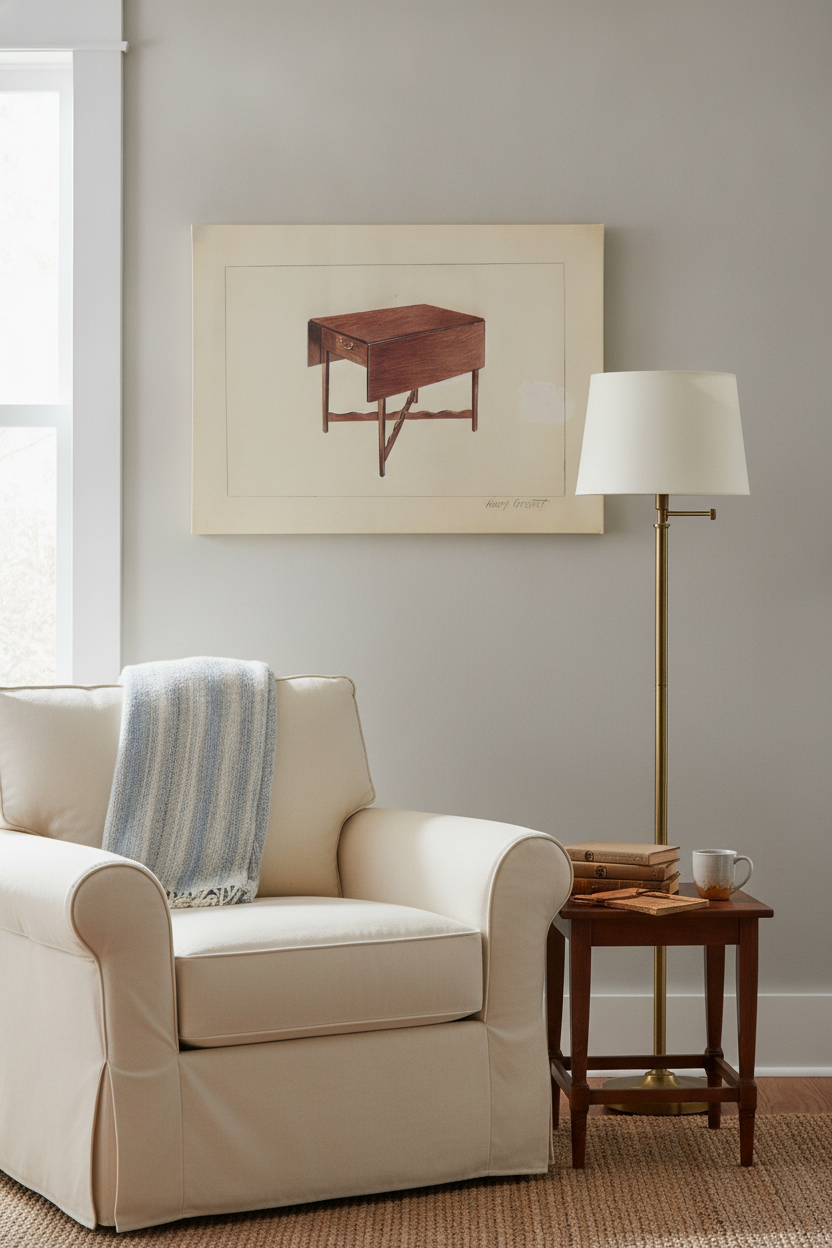
A perfect example of this is his work "Drop-Leaf Table" (1936). In this piece, the simple geometry of a wooden table becomes a study in form, light, and shadow. By treating everyday objects with the reverence of classical monuments, Granet reminds us that beauty and balance can be found in the quiet corners of our daily routines.
Why Granet's Art Belongs in the Modern Home
Modern interior design often strives for minimalism, but clean lines can sometimes feel cold. This is where Granet’s work becomes a powerful addition to a home. His compositions offer the clean, structured lines of modern design, but with a warmth and depth that only classical art can provide.
As a high-quality print or canvas, a Granet piece acts as a visual anchor in a room. Whether placed in a busy entryway or above a quiet reading chair, his balanced landscapes and serene interiors invite viewers to pause and reflect. They bring a touch of timeless, quiet beauty to the spaces we live in every day.
Frequently asked questions
What artistic movement does Henry Granet belong to?
Henry Granet is deeply rooted in the Classical tradition. His work prioritizes structural harmony, intellectual clarity, and a reverence for antiquity, using balanced compositions and soft light rather than dramatic emotion.
How does Granet use light differently from other classical painters?
While many artists use light and shadow to create drama, Granet uses it to establish a serene, enduring order. His subtle tonal transitions and restrained palette create a calm, contemplative atmosphere.
Would a Granet print suit a modern, minimalist home?
Absolutely. Granet's emphasis on structural harmony and clean, organized space complements minimalist aesthetics perfectly, adding a layer of warmth, history, and quiet beauty without cluttering the room.