Why is Agnolo Gaddi's art so luminous?
In short: Agnolo Gaddi bridged the gap between Giotto's dramatic realism and the decorative elegance of the Late Gothic. His signature pastel palette, graceful lines, and storytelling make his work perfect for bringing warmth and historic charm into modern spaces.
The Master of Pastel and Grace
In the bustling workshops of late fourteenth-century Florence, one painter brought a distinct, airy softness to a world of heavy stone and solemn devotion. Agnolo Gaddi was not just any painter; he was the son of Taddeo Gaddi, who had been Giotto's closest pupil and assistant. This lineage gave Agnolo a direct connection to the greatest revolution in Western art. Yet, instead of simply copying the monumental realism of his predecessors, Agnolo did something remarkable: he infused Florentine art with a delicate, courtly elegance and a luminous, pastel-toned color palette that seemed to glow from within.
Why is his work so luminous? Gaddi pioneered a shift away from saturated, heavy pigments toward lighter, more atmospheric hues—soft pinks, pale mint greens, gentle lavenders, and shimmering golds. This decorative sensibility transformed sacred stories into poetic, visually arresting narratives. You can see this exquisite approach in his multi-panel altarpieces, such as the Madonna and Child Enthroned with Twelve Angels, and with the Blessing Christ [middle panel], where the divine figures are bathed in a gentle, heavenly light that feels both ancient and remarkably fresh.
![Saint Andrew and Saint Benedict with the Archangel Gabriel [left panel]](https://pub-13a1a0fce6b84e01bbb44f17cde61fc9.r2.dev/social/lifestyle/f6fb6550916a3458/1.jpg)
Bridging Two Artistic Worlds
Gaddi worked during the late Trecento (the late 1300s), a fascinating transitional period in Italian art history. Florence was recovering from the devastation of the Black Death, and artists were searching for ways to express both profound faith and human warmth. Gaddi's workshop became one of the most influential of its time by perfectly balancing two worlds. On one hand, he kept the monumental, three-dimensional realism of Giotto. On the other, he introduced a new, courtly decorative sensibility characterized by flowing lines, elegant drapery, and intricate details.
His masterwork fresco cycles, particularly those in the Basilica of Santa Croce in Florence, showcase this blend beautifully. Here, Gaddi was tasked with telling the legend of the True Cross. He did so with an extraordinary ability to weave grand, sacred history with intimate, observational details of contemporary Florentine life. In his hands, ancient saints and biblical figures wear the fashionable, softly draped garments of fourteenth-century merchants, making the divine stories feel wonderfully close, human, and alive to the local viewers.
The Harmony of the Altarpiece
To truly appreciate Gaddi's narrative genius, one must look at how he structured his multi-panel altarpieces. His compositions are complex yet they never feel cluttered; instead, they flow with a gentle, musical rhythm. For instance, in his larger altarpiece projects, he flanked central devotional scenes with beautifully characterized saints.
In his surviving triptych panels, figures of Saint Andrew, Saint Benedict, Saint Bernard, and Saint Catherine of Alexandria stand with a quiet, contemplative grace. These side panels create a harmonious visual dialogue with the central imagery, unified by Gaddi’s signature soft lighting and delicate linear rhythms that guide the viewer's eye across the entire ensemble.
Why Gaddi Belongs in the Modern Home
Why do Gaddi’s works translate so beautifully into modern homes as fine-art prints or canvases? The answer lies in his unique color palette and gentle atmosphere. Unlike the dark, heavy oil paintings of later centuries, Gaddi's tempera-and-fresco style relies on light, breathable tones. His soft pinks, pale blues, and warm golds fit effortlessly into contemporary interior design, offering a sophisticated pop of color without overwhelming a room.
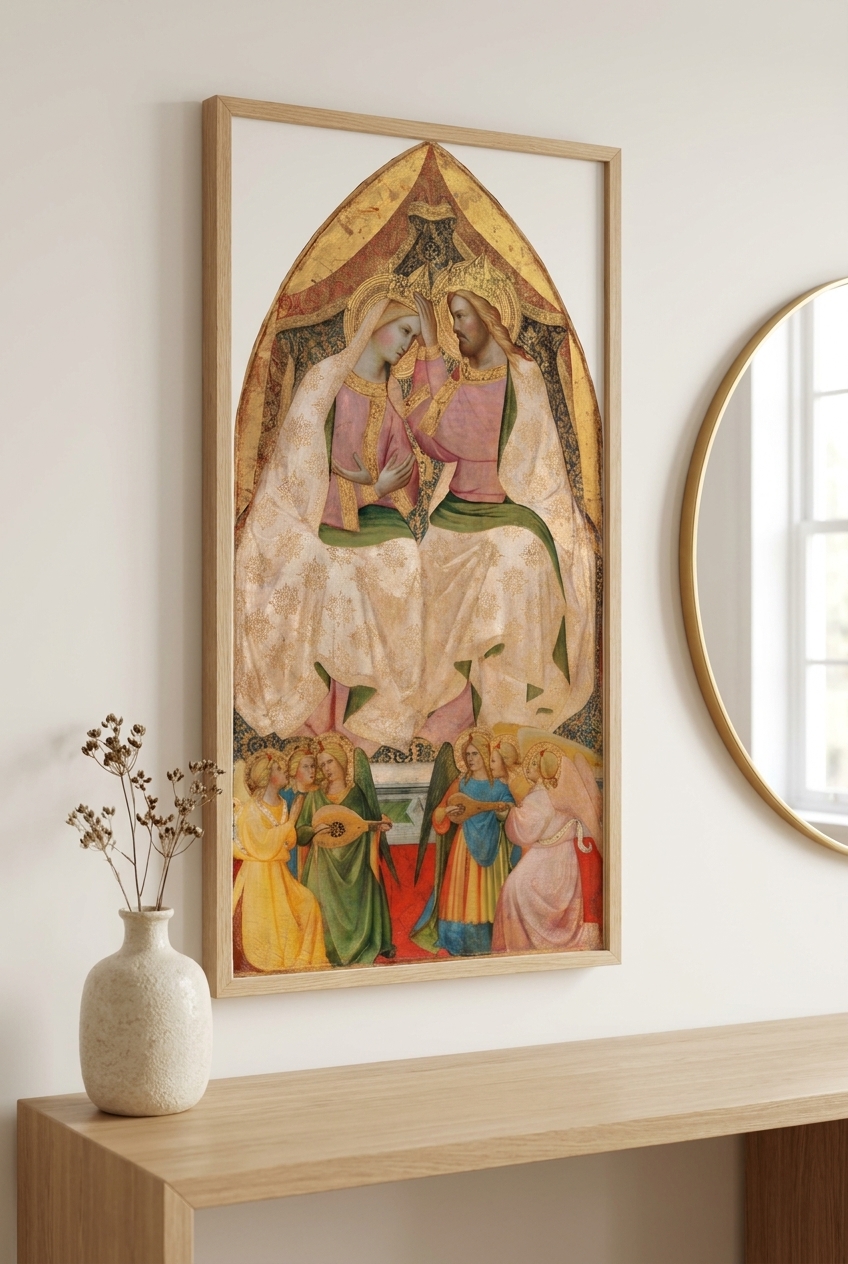
A high-quality print of The Coronation of the Virgin with Six Angels brings a sense of serene, historic elegance to a living room, bedroom, or study. It acts as a window into late-medieval Florence, offering both a calming visual retreat and a rich conversation piece. Exploring the Full Agnolo Gaddi collection reveals how these centuries-old masterpieces can bring a timeless, luminous grace to our modern everyday spaces.
Frequently asked questions
Who was Agnolo Gaddi?
Agnolo Gaddi (c. 1350–1396) was an influential Florentine painter of the Late Gothic period. He was the son of Taddeo Gaddi, who was Giotto's primary pupil, making Agnolo a key figure in carrying forward and refining the Giottesque artistic tradition.
What defines Agnolo Gaddi's painting style?
Gaddi's style is celebrated for its luminous, pastel-toned color palette (featuring soft pinks, greens, and lavenders), delicate linear rhythms, and a courtly, decorative elegance that softened the monumental realism of earlier Florentine art.
Where can Gaddi's most famous works be seen today?
His most famous fresco cycles are located in the Basilica of Santa Croce in Florence, Italy. Many of his portable panel paintings and altarpieces are preserved in major museums worldwide, including the National Gallery of Art in Washington, D.C., and the Uffizi Gallery in Florence.
Why do Gaddi's artworks make good prints for modern interiors?
His use of light, airy pastel tones and gold accents provides a gentle, warm aesthetic that complements modern, minimalist, or transitional home decor. The soft colors and elegant lines offer historical depth without the visual heaviness of later Baroque or Renaissance oil paintings.
![Madonna and Child Enthroned with Twelve Angels, and with the Blessing Christ [middle panel]](https://pub-13a1a0fce6b84e01bbb44f17cde61fc9.r2.dev/social/lifestyle/b7e116f8442ab580/1.jpg)
![Saint Bernard and Saint Catherine of Alexandria with the Virgin of the Annunciation [right panel]](https://pub-13a1a0fce6b84e01bbb44f17cde61fc9.r2.dev/social/lifestyle/9a7e6a18abfec18b/1.jpg)